
+86-574-87520996
sales@fzmag.com
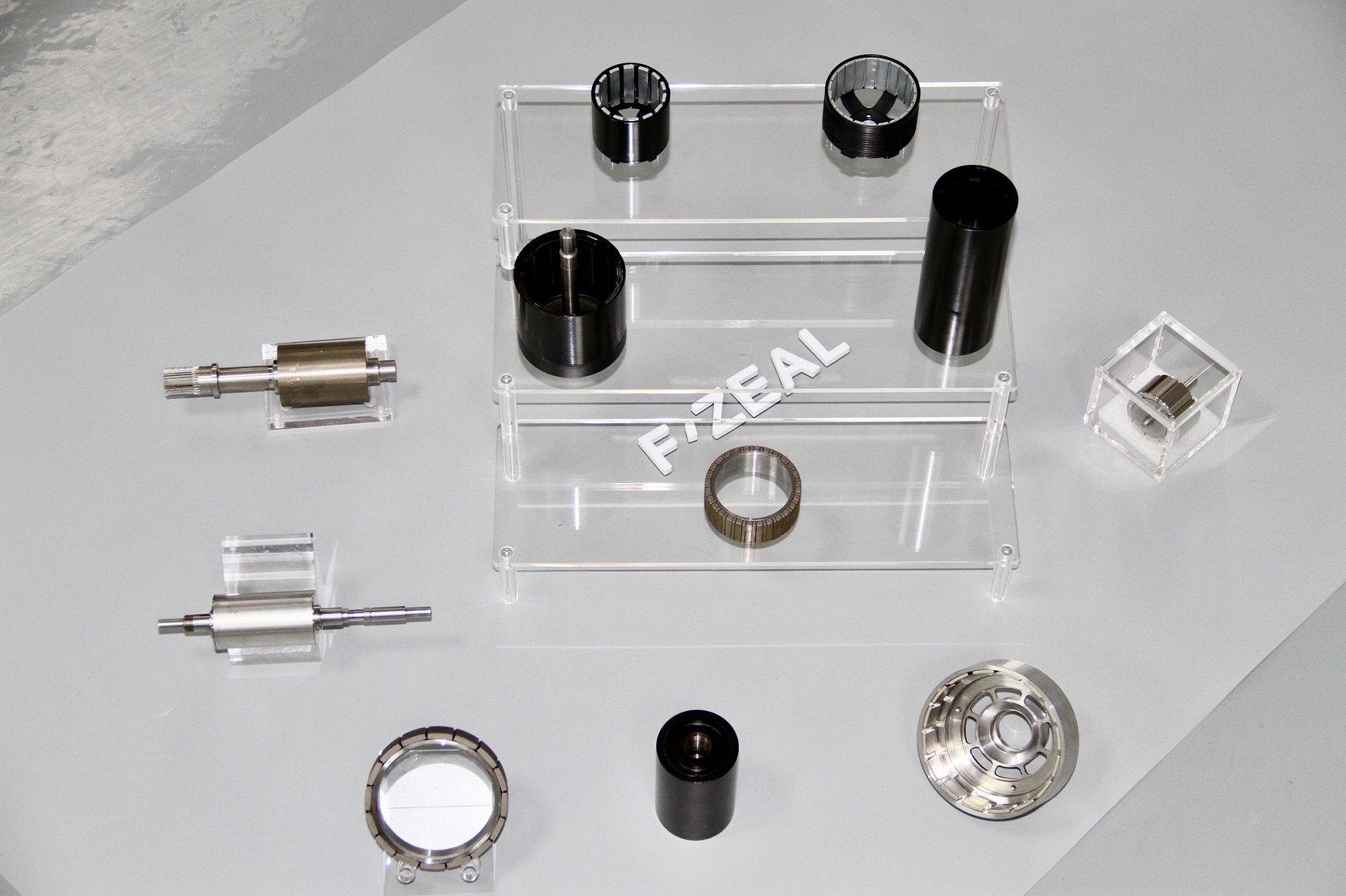
The FAIZEAL product showcase pictured here brings together a representative cross-section: SmCo rotors for high-temperature motors, sintered NdFeB drone motor rotors, robot joint rotors, servo stator arc segments, magnetic encoder rings, and arc-segment Halbach assemblies — spanning micro-motors through medium-format industrial machines. This guide walks through the application landscape, material selection, magnetic circuit design, manufacturing processes, and reliability challenges that define the modern motor magnet industry.
In motor engineering, the strongest magnet is not always the right magnet. Four parameters drive the decision: remanence Br, coercivity HcJ, maximum operating temperature, and corrosion resistance.
Sintered Neodymium Iron Boron (NdFeB) is the highest-performance commercial permanent magnet. Grades from N35 to N54 deliver remanence of 1.05 to 1.45 T and maximum energy products of 240 to 474 kJ/m³. It is the default choice for high power-density servo motors, robot joint motors, drone motors, and EV traction motors. Suffix letters — H, SH, UH, EH, AH — denote operating temperature ratings from 80°C up to 240°C. In humid or salt-spray environments, surface coatings such as Ni-Cu-Ni triple-layer plating, epoxy coating, or Parylene vacuum impregnation are mandatory.
Samarium Cobalt (SmCo) comes in two families: 1:5 (SmCo5) and 2:17 (Sm2Co17). With remanence of 0.85 to 1.15 T, SmCo trails NdFeB in strength but offers coercivity up to 700–1500 kA/m, exceptional thermal stability up to 250–350°C, and inherent corrosion resistance. SmCo is the material of choice for high-temperature, high-demagnetization-risk, low-permeability environments: aerospace motors, downhole drilling, industrial high-temperature pumps, radar drives, medical MRI gradient coils, and spacecraft reaction wheels.
Bonded NdFeB combines NdFeB powder with nylon, epoxy, or PPS binders through injection molding. Remanence sits between 0.6 and 0.85 T, energy product 50 to 120 kJ/m³. Its strengths are geometric freedom, high dimensional accuracy, and batch consistency; its weakness is magnetic strength. Bonded NdFeB dominates low-cost BLDC fans, office spindle motors, magnetic encoder rings, small gear motors, and micro drone prop motors.
Ferrite delivers 0.35 to 0.45 T and 25 to 40 kJ/m³ — the lowest cost, the best thermal stability (200°C+), and excellent corrosion resistance. It remains dominant in home appliances, washing-machine inverter motors, AC outdoor units, low-speed EVs, and entry-level pumps.
The engineering decision logic is straightforward: define the operating temperature and lifetime, then the remanence requirement, then the cost ceiling. High-temperature, shock-loaded, demagnetization-risk scenarios require SmCo. High power density, volume-constrained, room-temperature motors require sintered NdFeB. Geometrically complex, cost-sensitive, lightweight motors favor bonded NdFeB or ferrite.
Magnetic circuit topology defines a motor's character. The same magnet assembly can deliver very different performance depending on the topology.
Radial Flux is the industry's workhorse. N and S poles alternate along the rotor radius; flux crosses the air gap into stator teeth and returns through the stator yoke. Radial flux motors are easy to cool, mature in manufacturing, and well suited to medium and high speeds. They are the default for the bulk of BLDC and PMSM designs. Most arc-segment magnets and steel-back-iron rotors shown in the F-ZEAL image fall into this category.
Axial Flux places the magnetic path along the motor axis, with a flat annular air gap. Axial flux motors offer very short magnetic paths, extreme torque density (exceeding 10 kW/kg), and slim form factors. They are preferred for in-wheel motors, direct-drive EVs, distributed electric aircraft propulsion, and compact robot joint drives. Axial flux magnets are typically rectangular or sector tiles requiring extremely tight flatness and parallelism tolerances.
Halbach Arrays rotate the magnetization vector along the rotor circumference, concentrating flux on the air-gap side while nearly eliminating leakage on the outer side. Three engineering wins follow: air-gap flux density increases by 30 to 60 percent, stator yoke can be thinned by 15 to 25 percent, and cogging torque drops by over 30 percent. Halbach is decisive in high-end servo, robot joint, aerospace, and maglev propulsion applications. The arc-segment Halbach rotor at the lower right of the F-ZEAL image is a textbook example.
Skewing tilts the magnet segments by a small angle along the circumference — typically 5° to 10° — to average out cogging torque. The trade-off is a 1% to 3% back-EMF reduction against a 60% to 80% cogging-torque reduction. For servo and robot motors running at low speed, this trade is unambiguously worth making. Several rotors in the F-ZEAL image already incorporate skew features.
Fractional-Slot Concentrated Windings (FSCW) paired with multi-pole magnets reduce cogging torque and harmonic losses simultaneously. Common pole/slot combinations include 8-pole/9-slot, 10-pole/12-slot, and 14-pole/12-slot for high-end servo and drone motors.
Industrial servo motors, humanoid robots, and cobots share a single set of demands: high power density, high dynamic response, high positioning accuracy, and cogging-free low-speed operation. Magnets must deliver simultaneously high energy product, low cogging torque, and excellent thermal stability.
The F-ZEAL image highlights typical knee joint, shoulder joint, and finger joint rotors. They share several structural signatures: arc-segment assembly, post-magnetization, G2.5 or better dynamic balance, and total runout within 0.03 mm.
Knee joint motors, with outer diameters from 60 to 100 mm, typically use 10- or 14-pole Halbach arc-segment rotors in N42SH or N40UH grade, mated to 9-slot or 12-slot stators. Peak torque reaches 30 to 80 Nm, peak power density exceeds 5 kW/kg. Shoulder joint motors (40 to 70 mm OD) are dominated by skewed radial rotors in N42SH or N40UH with skew angles of ±7.5° to ±10°, paired with 17 to 23-bit encoders. Finger joint motors (10 to 18 mm OD) use micro Halbach rings, 8 or 10 poles, arc thickness 1.5 to 2.5 mm, with tolerances of ±0.01 mm in thickness, ±0.3° in cumulative angular error, and total runout below 0.02 mm.
The companion component for every servo motor is the magnetic encoder ring. Most encoder rings use 32 to 64 pole bonded NdFeB or sintered NdFeB rings with stable remanence and low harmonic distortion, mated to ASIC encoder chips such as AS5048 or TLE5012 to deliver 17 to 23-bit single-turn resolution.
Drone motors push power density to its limits. The F-ZEAL image shows a representative outer-rotor drone stator — ring-slot structure, exposed winding, thin and large in diameter. This geometry corresponds to outer-rotor BLDC or PMSM topologies.
Drone motor duty is brutal: short bursts at 3 to 10 times rated power (5 to 20 minutes of flight), high speeds (10,000 to 30,000 rpm), extreme weight sensitivity, severe vibration, and high temperature rise. Magnet engineering responses: N42SH to N48SH sintered NdFeB for high energy product, thin laminated silicon-steel or amorphous stator cores, lightweight aluminum or carbon-fiber housings, G1.0 dynamic balance, anti-salt-spray surface treatment for maritime UAVs, and 150°C short-term thermal endurance.
High-end cinematography, agricultural, logistics, and inspection drones now routinely use 0.5 to 5 kW outer-rotor motors. Stator outer diameters range from 30 to 80 mm, stack lengths from 5 to 15 mm, rotor outer diameters from 50 to 120 mm. F-ZEAL's sintered NdFeB rotor product range is shipping in volume to this market.
Aerospace motors — eVTOL, electric vertical take-off and landing aircraft, drone carrier platforms — extend the requirements further: high specific power, long service life, wide temperature range, radiation tolerance (in some cases), and airworthiness certification. SmCo, particularly 2:17, takes a larger share here than in ground-based drones — its ability to operate stably from -55°C to +200°C, combined with oxidation and corrosion resistance, makes it the preferred choice.
EV traction motors have completed the transition from induction machines (IM) to permanent magnet synchronous machines (PMSM) over the past decade. Tesla Model 3 and Model Y, BYD Han, and CATL XFC platforms all use NdFeB interior permanent magnet (IPM) rotors.
EV traction motor challenges: torque density ≥ 5 kW/kg, wide constant-power region (4 to 6× base speed), peak efficiency above 95% on CLTC duty cycles, 15-year / 300,000 km service life, plus vibration, condensation, and ATF oil resistance.
Magnet engineering responses: segmented skewed IPM rotors in V-shape, I-shape, or double-V layout, N42UH to N48UH grades for 150°C to 180°C continuous operation, epoxy surface coating passing 96h salt spray, G2.5 dynamic balance, 100% ultrasonic and magnetic-particle crack detection, and per-piece traceable IDs. Stator outer diameters reach 200 to 280 mm, stack lengths 100 to 200 mm, speeds up to 16,000 rpm (some platforms beyond 20,000 rpm), peak power 200 to 350 kW, peak torque 350 to 500 Nm. F-ZEAL's sintered NdFeB arc segments and rotor assemblies are volume-ready for this market.
Home appliance motors chase extreme cost and reliability: mild thermal conditions (80°C to 120°C), 10-year-plus service life. Ferrite dominates this market, but as appliances move toward inverter, miniaturization, and premium performance, bonded NdFeB and sintered NdFeB keep gaining share.
Applications include inverter air-conditioner outdoor BLDC fans, direct-drive washing machines, inverter refrigerator compressors (BLDC/PMSM), range-hood high-speed motors, range-hood impellers, air purifiers, water purifiers, smart-toilet pumps, and robot-vacuum drive and side-brush motors.
Bonded NdFeB's advantages in this space: injection molding integrates shaft, end ring, and flange in one piece; dimensional accuracy reaches ±0.02 mm; no plating required; ideal for automated high-volume production. The small-format ring magnets in the F-ZEAL image are representative.
Onshore and offshore wind turbines favor direct-drive permanent magnet synchronous generators (PMSG) or hybrid PMSG designs. Unit power ranges from 3 MW to 16 MW, rotor diameters reach several meters, and magnet material usage is measured in tons per turbine.
Wind turbine magnets demand: 25-year service life, typhoon vibration tolerance, salt-spray resistance, thermal cycling from -30°C to +60°C, and partial demagnetization tolerance against grid-fault short-circuit currents. Materials are typically N38SH to N42SH sintered NdFeB; some platforms are exploring SmCo to widen the thermal margin. F-ZEAL's full-ring sintered magnets — up to Ø300 to Ø500 mm — serve small and medium-format wind turbine customers.
Magnetic encoders are the eyes of every servo system, combining a multi-pole magnet ring and a sensor ASIC to deliver 14 to 23-bit resolution. Applications span servo motor encoders, robot joint encoders, automotive EPS steering-angle encoders, drone gimbal encoders, AGV wheel encoders, machine-tool spindle encoders, and FOC feedback in drone motors.
Encoder rings typically use 32, 48, 64, 96, or 128-pole bonded NdFeB or sintered NdFeB rings. Key precision metrics: pole-pitch accuracy within ±0.5°, remanence consistency within ±1%, and harmonic distortion below 3%. The small-format ring magnets in the F-ZEAL image are textbook encoder ring geometries.
Motor operation subjects magnets to a compound stress envelope — thermal, electrical, mechanical, and environmental. Demagnetization is the headline failure mode: once the operating point passes the knee of the demagnetization B-H curve, irreversible flux loss is permanent.
Engineering responses: finite-element simulation of worst-case operating points on the magnet, selection of grades with high HcJ and low remanence temperature coefficient (SmCo, low-temperature-coefficient NdFeB grades), retention of at least 1.3× demagnetization safety margin, and use of SmCo where necessary.
Mechanical failures include magnet cracking, sleeve loosening, and back-iron cracking, typically caused by improper interference fit, shock loads, or thermal fatigue. Responses: finite element analysis, precise interference control, buffer adhesives, end-ring protection, and 100% CT inspection.
Corrosion failures stem from salt spray, humidity, and condensation. NdFeB must pass qualified surface treatments — 96h salt spray, moisture-proof packaging.
F-ZEAL shipment documents include VSM demagnetization curves, CMM dimensional reports, salt-spray reports, dynamic balance reports, runout inspection, polarity N/S distribution, and PPAP first-article approvals.
Q: Sintered NdFeB or SmCo — which to choose? A: Room temperature and high power density favor NdFeB; high temperature, severe demagnetization risk, and long life favor SmCo.
Q: Is Halbach always worth the cost? A: Yes for high-dynamic servo, robot, and aerospace motors; not necessary for cost-sensitive general-purpose motors.
Q: Does skewing sacrifice torque? A: Yes, back-EMF drops 1% to 3%, but cogging torque drops 60% to 80%, a clear win in servo scenarios.
Q: N42SH or N48SH for drone motors? A: N48SH for short-burst high-power drones, N42SH for continuous-duty platforms.
Q: What is the typical magnet lifetime in motor applications? A: Within rated conditions, irreversible NdFeB loss is below 2% over 10 years; SmCo below 1% over 10 years.