
+86-574-87520996
sales@fzmag.com
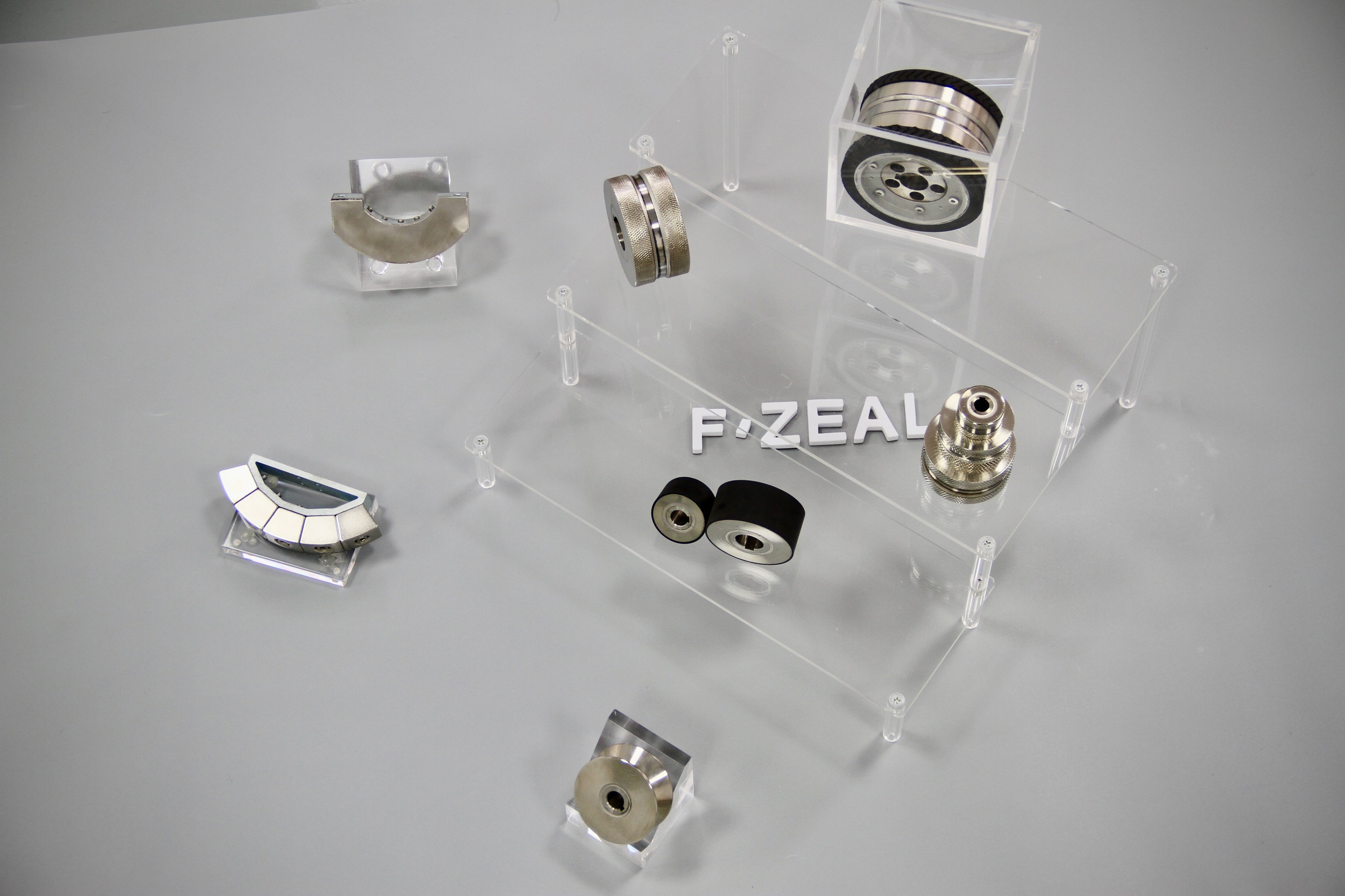
A magnetic wheel is a compact permanent-magnetic adhesion unit: multiple sintered NdFeB magnet segments arranged radially or in a Halbach pattern inside a steel back-iron, with the magnetic force and shear force transmitted through a thin outer rim made of steel or rubber.
The normal holding force is the headline metric. Under tight air gap (≤ 0.1 mm) and clean surface conditions, the holding force of a single circular magnetic wheel can be approximated from the Maxwell stress tensor as:
F_n ≈ B² · A / (2μ₀)
where B is the air-gap flux density (typically 0.3 to 0.6 T), A is the effective air-gap area in m², and μ₀ is the vacuum permeability (4π × 10⁻⁷ H/m). For example, a circular magnetic wheel of 60 mm outer diameter and 20 mm stack length can deliver a theoretical holding force of 200 to 400 N, equivalent to 20 to 40 kgf payload.
In real engineering, air gap, surface roughness, coatings, and magnetic circuit saturation all erode holding force. A common empirical correction is:
F_actual ≈ η · (B² · A / (2μ₀))
where η is a combined efficiency factor, typically 0.3 to 0.5 in practice. Every 0.1 mm increase in air gap reduces holding force by roughly 30% to 50%.
Shear force (anti-slip force, which determines whether the wall-climbing robot can hold its position) is given by the friction law:
F_shear = μ_s · F_n
The steel-on-steel friction coefficient μ_s is about 0.4 to 0.6, while rubber-on-steel μ_s is about 0.7 to 0.9. This is why rubber-sealed magnetic wheels dominate in wet, painting, and cleaning applications — for the same NdFeB holding force, the rubber rim delivers 30% to 50% more anti-slip force.
A Halbach-array magnetic wheel rotates the magnetization vector along the circumference and concentrates the air-gap flux on the load side, boosting air-gap flux density by 30% to 60%. The equivalent holding force is:
F_Halbach ≈ k · F_conventional
with k between 1.3 and 1.6. The trade-off is more complex manufacturing and higher unit cost; Halbach is reserved for extreme-load scenarios such as wind turbine blade inspection and offshore drilling platforms.
FAIZEAL organizes magnetic wheels into four product families:
Standard circular magnetic wheels: outer diameter 30 to 200 mm, stack length 10 to 60 mm, steel back-iron with NdFeB, center bore, keyway. Bolt directly to a motor-gearbox assembly to form the drive wheel of a wall-climbing robot. Typical applications: wind tower cleaning, storage tank exterior inspection.
Arc-segment (curved) magnetic wheels: single arc angle 10° to 60°, can be assembled into large-diameter ring magnetic wheel groups to adapt to large-curvature surfaces such as wind turbine nacelles and chemical reactor shells.
Rubber-sealed magnetic wheels: outer rim clad in NBR or silicone rubber, protection rating IP65 to IP67. Suited for ship waterlines, tank bottoms, offshore platforms, and any wet, salt-spray, or oil-contaminated environment. The rubber rim also lifts the friction coefficient from 0.5 to above 0.8, dramatically improving climbing anti-slip.
Customized magnetic wheels: non-standard shafts, integrated flanges, integrated encoder magnet pockets, embedded cable channels, explosion-proof housings, anti-static coatings, low-temperature -40°C grades, magnetic shielding (for medical MRI zones). Typical lead time 15 to 30 days.
Wall-climbing robots (also called magnetic crawler robots) are the most direct application of magnetic wheels. The typical architecture pairs four or six magnetic wheels with drive motors, gearboxes, vacuum or photoelectric sensors, cameras, and tool heads (nozzles, scrapers, welding torches, ultrasonic probes, magnetic-particle inspection heads).
The engineering performance targets for wall-climbing robots are: per-wheel payload 10 to 50 kg, total robot weight 20 to 80 kg, maximum climbing speed 5 to 30 m/min, wind tolerance (stable in Beaufort 6), obstacle crossing capability (≤ 5 mm welds, ≤ 10 mm flange steps), endurance 4 to 8 hours, and dual-failsafe anti-fall protection.
The key design constraint is the specific holding force: holding force per unit of robot weight. The empirical safety factor is 5× to 10×. For a 30 kg robot, the total required holding force is at least 1500 N, or 375 N per wheel for a four-wheel layout. This drives the NdFeB grade to N38SH or above, and pushes the design toward Halbach or larger-diameter configurations.
FAIZEAL's rubber-sealed magnetic wheels continue to gain share in the wall-climbing robot market, mainly because of their reliability in wet, painting, and cleaning operations. NBR rubber rings are oil-resistant; silicone rings deliver weather and low-temperature (-40°C) performance.
Wind energy is the single largest industry application for magnetic wheels, split across three sub-scenarios.
Wind tower exterior inspection and maintenance: steel towers 60 to 160 m tall require periodic repainting, cleaning, weld inspection, and recoating. Magnetic-wheel wall-climbing robots accomplish this autonomously, climbing at 6 to 12 m/min and covering 100 to 200 m² per run.
Nacelle exterior and hub shroud: spherical or near-spherical structures 4 to 8 m in diameter. Scaffolding is expensive and high-risk. Multi-arc magnetic wheel assemblies (8 or 12 segments) form a ring adhesion surface for adaptive curved climbing.
Blade interior and surface: blades 40 to 100 m long, with internal stiffeners and cable bridges. Compact magnetic wheels (30 to 50 mm OD, 3 to 5 kg) mounted on a tracked chassis reach into the blade interior for visual and ultrasonic inspection.
Wind-environment requirements on the magnetic wheel: 96h to 240h salt spray resistance, UV resistance, -40°C to +60°C thermal cycling, condensation resistance, and lightning-induced magnetic interference tolerance in some cases. FAIZEAL standard magnetic wheels are certified to EN 12944 corrosion protection and IEC 61400 wind environment standards.
Marine is the second major battlefield. Typical operations include: hull underwater cleaning, biofouling removal, cathodic protection inspection, oil tank level monitoring, weld magnetic-particle inspection, and hull painting.
Hull cleaning robots: equipped with multiple Halbach magnetic wheels (80 to 150 mm OD, 30 to 50 mm stack), total holding force 3000 to 8000 N, payload 50 to 150 kg, working depth 0 to 30 m. NdFeB grade N40UH or N42UH (thermal rating 150°C to 180°C for tropical port temperatures and direct sun exposure).
Oil tank and ballast tank inspection: entering confined spaces, the magnetic wheel must carry ATEX or IECEx explosion-proof certification and a low-permeability stainless-steel housing. FAIZEAL offers Ex db IIB T4 rated custom magnetic wheels.
Offshore wind service vessels and SOVs: hull inspection, offshore wind foundation pile inspection, and cross-sea bridge pier inspection all rely on permanent-magnetic adhesion climbing robots.
Marine-environment requirements are IP68 protection, anti-biofouling, rubber ring salt-spray resistance, and anti-magnetic-decay design (seawater 0°C to 35°C, with up to 0.5% salt concentration in some waters). FAIZEAL's rubber-sealed magnetic wheel sealing structure is rated for continuous duty at 30 m water depth.
Petrochemical and power scenarios center on confined-space entry, heavy corrosion resistance, explosion-proofing, and long service life.
Storage tank exterior inspection: 100,000 m³ crude oil tanks 80 m in diameter, 20 m wall height, need periodic corrosion, coating, and weld inspection on the outside. Magnetic-wheel climbing robots cover the full exterior at 200 to 500 m² per hour.
Boiler and pressure vessel interior inspection: boiler drums, reactors, and towers 2 to 6 m in diameter, with internal surface inspection (PT, MT, UT) relying on small magnetic wheel crawlers. FAIZEAL supplies 40 to 80 mm OD micro magnetic wheels with flexible chassis that can navigate bends and heads.
Pipeline exterior inspection: long-distance oil and gas pipelines 200 to 1200 mm diameter, with external corrosion monitoring. Ring magnetic wheel groups crawl along the outer wall at 0.5 to 2 m/s.
Nuclear power: nuclear island internals, steam generators, and pressurizers require radiation-tolerant (γ dose rate ≤ 100 kGy), low-activation magnetic wheels to avoid primary loop contamination. FAIZEAL supplies samarium cobalt (SmCo) circuit versions for combined radiation tolerance and thermal stability.
Power plant four-tube inspection: boiler water walls, superheaters, reheaters, and economizers are prone to tube rupture; magnetic wheel crawlers carry eddy-current, ultrasonic, and magnetic-flux-leakage probes for online monitoring.
Grade selection for petrochemical and power: N40UH to N48UH (continuous duty 150°C to 180°C); samarium cobalt (Sm2Co17) for higher temperatures (300°C+) or radiation environments.
The magnetic circuit is the engineering heart. Standard circular magnetic wheels use a radial circuit (N pole out / S pole in with steel back-iron), while Halbach magnetic wheels use 4- or 6-segment discrete magnetization to concentrate air-gap flux.
Material selection logic:
• Sintered NdFeB is the default (high remanence, large energy product)
• Samarium cobalt for high temperature (≥ 200°C) or radiation-resistant scenarios
• Ferrite for low-cost, light-load, sub-200°C scenarios
• Bonded NdFeB for complex geometries and high-volume production
Steel back-iron material is typically 10# steel or DT4 electrical pure iron, thickness 3 to 8 mm. DT4's high magnetic permeability reduces leakage and improves holding force by 10% to 20%.
Rubber ring materials by scenario:
• NBR: oil-resistant, wear-resistant, -30°C to +110°C — most common
• HNBR: ozone- and weather-resistant, -40°C to +150°C
• Silicone: high and low temperature (-60°C to +200°C), weather-resistant, insulating
• FKM / Viton: chemical-resistant, 200°C+, oil-resistant
Surface treatment for the steel housing: nickel plating, zinc plating, Dacromet, epoxy coating, phosphating — selected by salt-spray requirement (48h, 96h, 240h, 500h).
Magnetic wheels have clear surface requirements. The best surface is low-carbon steel, Q235, S355, and similar ferromagnetic materials, with roughness Ra ≤ 25 μm and flatness ≤ 0.5 mm/m.
Stainless steel splits into ferritic/martensitic (adhesive, holding force 70% to 90% of carbon steel) and austenitic (304/316, essentially non-adhesive, requiring rubber-friction or vacuum-assist alternatives). Aluminum, copper, fiberglass, and plastic are non-adhesive, and magnetic wheels will not hold on them.
Coating effects: paint coatings (≤ 200 µm) reduce holding force by only 5% to 15%; thick rubber coatings (≥ 2 mm), 3PE anti-corrosion layers, and polyurethane coatings push the air gap from 0.1 mm to above 0.5 mm, reducing holding force by 50% to 80%. FAIZEAL supplies large-gap (g ≤ 1 mm) specialized magnetic wheels, at the cost of lower specific holding force — requiring larger wheel diameters or more wheels.
Stainless steel 304/316 surface workarounds: FAIZEAL offers stainless-steel adapter pads or hybrid rubber-friction plus vacuum-assist solutions. In some cases a mechanical clamping arm replaces the magnetic wheel entirely.
The main failure modes in industrial deployments:
Demagnetization: high-grade NdFeB (N38SH, N40UH) tolerates 150°C to 180°C; above this, irreversible demagnetization occurs. Hot summer sun on wind towers reaches 70°C to 80°C (still safe), but operations near boilers and reactors require thermal shielding or distance control.
Corrosion: NdFeB is corrosion-vulnerable; failed surface protection in wet or salt-spray environments causes powdering and spalling. FAIZEAL magnetic wheels pass 96h to 500h neutral salt-spray tests (depending on coating grade); rubber-sealed versions pass 1000h humidity cycling.
Mechanical damage: housing dents, rubber ring cuts, keyway loosening, bore wear. FAIZEAL provides replacement parts kits (rubber rings, keys, bushings).
Magnetic decay: sintered NdFeB decays ≤ 0.1% per year at room temperature; SmCo ≤ 0.05%. Design lifetime 10 to 15 years at 8 hours per day.
Rubber fatigue: rubber rings replaced every 6 to 12 months; NBR delivers 8000 to 12000 km of rolling mileage in oily environments; silicone up to 30000 km.
MTBF: FAIZEAL standard magnetic wheels achieve MTBF ≥ 20000 hours under rated conditions. Full-life data sheets and on-site failure analysis are available on request.
FAIZEAL has run its in-house magnetic wheel product line for 8 years, with annual capacity exceeding 150,000 pieces. Product families cover standard circular magnetic wheels, arc-segment magnetic wheels, rubber-sealed magnetic wheels, Halbach magnetic wheels, explosion-proof magnetic wheels, radiation-resistant magnetic wheels, and medical-grade magnetic wheels.
Customizable parameters:
• Outer diameter 15 - mm
• Stack length 5 to 80 mm
• Per-wheel holding force 30 to 5000 N
• Grade N35 to N54 (NdFeB), SmCo5, Sm2Co17
• Protection IP54 to IP68
• Operating temperature -60°C to +250°C
• Salt-spray 48h to 1000h
• Explosion-proof ATEX/IECEx Ex db IIB T4 to T6
• Surface treatment: nickel, zinc, Dacromet, epoxy, phosphating, Parylene
• Integrated options: encoder, brake, cable channel, hub flange, keyway
Sourcing workflow:
1. Submit requirements: outer diameter, holding force, bore, surface, protection, temperature, lifetime target
2. FAIZEAL delivers DFM report, magnetic circuit simulation (ANSYS Maxwell / JMAG), sample plan, and mass-production quotation within 5 business days
3. Sample lead time 10 to 15 days, MOQ 1 piece
4. Mass-production MOQ 100 pieces, lead time 15 to 30 days
FAIZEAL shipment documents include VSM demagnetization curves, CMM dimensional reports, ANSYS/JMAG magnetic circuit simulation, salt-spray reports, protection rating reports, dynamic balance reports (for rotating magnetic wheels), and PPAP first-article approvals.
Q: Can a magnetic wheel hold on stainless steel 304? A: Austenitic stainless steel is essentially non-adhesive, so magnetic wheels are ineffective. Options: switch to ferritic/martensitic stainless, use a hybrid rubber-friction plus vacuum-assist solution, or replace the magnetic wheel with a mechanical clamping arm.
Q: Can a magnetic wheel climb a 90° vertical wall? A: Yes, but conditions must be met: per-wheel holding force ≥ robot weight × 5 to 10 safety factor; rubber rim; anti-fall safety rope; attitude sensor (gyroscope plus inclinometer).
Q: Can a magnetic wheel climb curved surfaces? A: Yes. The larger the radius of curvature, the easier the adhesion. For radii ≤ 100 mm, arc-segment magnetic wheels are recommended.
Q: Can a magnetic wheel operate submerged? A: FAIZEAL rubber-sealed magnetic wheels rated IP67 to IP68 support short-term duty at 30 m water depth. Long-term submersion requires oil-filled sealing or full potting.
Q: How to select the NdFeB grade? A: Room temperature (≤ 80°C): N35 to N42; high temperature (80°C to 180°C): N42SH to N48UH; very high temperature (200°C+) or radiation: Sm2Co17.
Q: What is the typical magnetic wheel lifetime? A: Under rated conditions, irreversible NdFeB loss is ≤ 2% over 10 years; SmCo ≤ 1% over 10 years; rubber rings replaced every 6 to 12 months; mechanical life 20000 to 50000 hours depending on bearing and shaft.
Q: What custom non-standard shapes are available? A: Non-standard shafts, integrated flanges, integrated encoder magnet pockets, embedded cables, explosion-proof housings, anti-static coating, low-temperature -40°C grade, magnetic shielding (medical MRI zones). FAIZEAL handles all of these with a 15 to 30 day lead time.
Q: How is magnetic wheel holding force tested? A: Use a pull-force gauge (or motorized pull-off rig) on a standard steel plate (GB 20# low-carbon steel, thickness ≥ 10 mm, Ra ≤ 1.6 µm). FAIZEAL tests 100% of production and provides the data.