The History of Permanent Magnets
From lodestone and the first compass to Alnico, hard ferrite and the rare-earth NdFeB revolution
Technical History · Materials Engineering | Engineering Reference | Four Material Generations
Introduction
The permanent magnet is among the most quietly indispensable components of modern industry. It converts electrical energy into motion in the motors of electric vehicles and industrial drives, holds flux in loudspeakers and sensors, couples torque through hermetic walls, and enables the precise positioning required by consumer electronics, wind turbines and medical imaging. Yet for most of human history the only known magnetic material was a naturally occurring iron ore — lodestone. The journey from that single mineral to today’s neodymium–iron–boron (NdFeB) magnets, whose magnetic energy density is roughly a hundred times that of the best steel, is a story of two intertwined advances: a scientific understanding of what magnetism is, and a materials-engineering pursuit of how to make it stronger, cheaper and more stable.
This article traces that chronology. It follows the physicists whose observations and laws converted magnetism from a curiosity into a quantitative science, and then the engineers who — from the twentieth century onward — developed the successive generations of permanent-magnet materials: the steel-magnet era, Alnico, the hard ferrites, and the rare-earth family of samarium–cobalt (SmCo) and neodymium–iron–boron (NdFeB). Each generation is examined in its chemistry, magnetic figures of merit and industrial role.
A “magnet material” is ultimately a measured compromise between four properties: how strongly it is magnetised, how stubbornly it resists demagnetisation, how much magnetic energy it stores per unit volume, and how well it survives heat, corrosion and cost.
Classification of Permanent-Magnet Materials
Commercial permanent magnets are grouped by chemistry into families, historically arranged in “generations” defined chiefly by their maximum energy product (BH)max. The four families that account for virtually all industrial use are Alnico, hard ferrite, samarium–cobalt (SmCo) and neodymium–iron–boron (NdFeB) — the latter two constituting the rare-earth class.
Key figures of merit
Remanence Br: the flux density remaining after the magnetising field is removed (mT or G) — how “strong” the magnet is.
Coercivity Hc / HcJ: the reverse field required to demagnetise it (kA/m or kOe); high coercivity means a “hard” magnet that resists demagnetisation and heat.
Energy product (BH)max: the maximum magnetic energy stored per unit volume — the single-figure benchmark of performance, in MGOe or kJ/m³ (1 MGOe ≈ 7.96 kJ/m³).
Max service temperature: the practical operating limit, governed by the Curie temperature Tc and the magnet’s coercivity grade.
The four material families
Alnico (1st engineered alloy)
Fe–Al–Ni–Co (+ Cu, Ti); cast or sintered · Mishima, 1931.
~5–9 MGOe (40–75 kJ/m³); Br 0.70–1.35 T; usable to ~500–550 °C. Very high remanence and excellent temperature stability and corrosion resistance (used unpainted), but lower coercivity — designed with long magnetic paths or keepers. Kept in precision instruments, rotating machinery, sensors and loudspeakers where temperature cycling is severe.
Hard ferrite (2nd generation · ceramic)
BaFe₁₂O₁₉ / SrFe₁₂O₁₉; sintered or bonded ceramic · Philips, 1950–52.
~1–4 MGOe (8–32 kJ/m³); Br 0.30–0.45 T; usable to ~250–300 °C. High coercivity for its class, electrically insulating and demagnetisation-resistant; low remanence and brittle, but extremely low cost (chiefly iron oxide) and corrosion-proof. The volume champion for DC motors, loudspeakers, separators, holding magnets, appliances and automotive sensors.
Samarium–cobalt SmCo (3rd generation · rare earth)
SmCo₅ (1:5) and Sm₂Co₁₇ (2:17); sintered · Strnat, 1966 / early 1970s.
~16–33 MGOe (128–263 kJ/m³); Br 0.82–1.15 T; usable to ~250–350 °C. High energy product with exceptional temperature stability and corrosion resistance (used uncoated); brittle and expensive due to cobalt. The premium choice for aerospace, defence and high-temperature engineering — turbine-area sensors, high-temperature motors and couplings, travelling-wave tubes and precision instruments.
Neodymium–iron–boron NdFeB (4th generation · rare earth)
Nd₂Fe₁₄B; sintered / bonded / hot-deformed · Sagawa & Croat, 1982–83.
~30–55 MGOe (240–440 kJ/m³), the highest of all; Br 1.0–1.5 T; typically usable ~80–220 °C by grade. Maximum energy density and remanence, but a lower Curie temperature (raised with Dy/Tb) and susceptibility to corrosion — almost always protected by Ni–Cu–Ni plating, epoxy or zinc. The workhorse of modern magnetics: EV/hybrid traction motors, wind-turbine generators, servo and stepper motors, MRI, hard-disk voice coils, separation, consumer electronics and industrial automation. Sintered grades maximise strength; melt-spun bonded grades give low-cost net shapes.
Performance comparison across generations
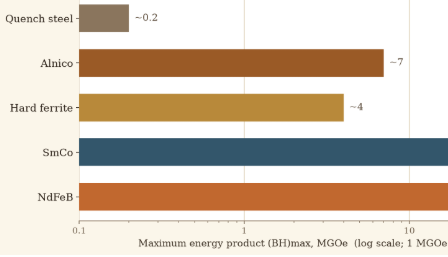
Figure 3. Representative maximum energy product (BH)max by material family, on a logarithmic scale, showing the roughly hundred-fold gain from steel to modern NdFeB.
Table 1. Representative properties of the principal permanent-magnet families
Typical room-temperature ranges across commercial grades; for comparison and education, not design selection. HcJ = intrinsic coercivity. Conversion: 1 MGOe ≈ 7.96 kJ/m³; 1 kA/m ≈ 12.57 Oe.
Material family |
Principal phase / composition |
Br (T) |
HcJ (kA/m) |
(BH)max (MGOe) |
Max temp (°C) |
Corrosion resistance |
Relative cost |
Alnico (cast/sintered) |
Fe–Al–Ni–Co (+ Cu, Ti) |
0.70–1.35 |
~40–150 |
5–9 |
~500–550 |
Excellent |
Moderate (Co-bearing) |
Hard ferrite (ceramic) |
BaFe₁₂O₁₉ / SrFe₁₂O₁₉ |
0.30–0.45 |
~150–300 |
1–4 |
~250–300 |
Excellent |
Very low |
Samarium–cobalt SmCo₅ |
SmCo₅ (1:5) |
0.82–0.95 |
~1,200–2,400 |
16–24 |
~250 |
Excellent |
High |
Samarium–cobalt Sm₂Co₁₇ |
Sm₂(Co,Fe,Cu,Zr)₁₇ |
1.0–1.15 |
~800–2,000 |
22–33 |
~300–350 |
Excellent |
High |
NdFeB, sintered |
Nd₂Fe₁₄B (+ Dy/Tb for high-temp) |
1.0–1.5 |
~800–2,800 |
30–55 |
~80–220 |
Low (coatings required) |
Moderate; high for high-temp |
NdFeB, bonded |
Melt-spun Nd₂Fe₁₄B + polymer |
0.6–0.8 |
~600–1,200 |
6–12 |
~120–150 |
Good (matrix-encapsulated) |
Low–moderate |
Outlook
Eight centuries separate Petrus Peregrinus’s pivoted needle from the sintered NdFeB rotor in an electric-vehicle traction motor. The arc of that history shows a consistent pattern: each generation trades a different balance of the core magnetic properties — remanence, coercivity, energy product, thermal stability and cost — rather than simply exceeding the last. Ferrite remains the volume champion because it is cheap and robust; Alnico endures where heat is extreme; SmCo serves the most demanding high-temperature and corrosion environments; and NdFeB supplies the maximum energy density that enables the compact, high-efficiency machines of the energy transition.
The current frontier is less about raising peak energy product than about securing the supply chain: reducing reliance on the heavy rare earths dysprosium and terbium through grain-boundary diffusion, improving the temperature tolerance and corrosion resistance of NdFeB, and maturing rare-earth-lean and rare-earth-free alternatives. The magnet that quietly drives the modern world continues to evolve in the same spirit — measured, engineered compromise — established by the pioneers in this timeline.
References & Further Reading
WZ Magnetics — History of magnet manufacture (barium hexaferrite, Philips 1950–52)
Note: Property figures are typical ranges for comparison and education; consult the relevant material data sheets for design-critical applications. The scientist portraits are stylised vintage engravings created as illustrative artwork for this article, not archival photographs.
About Us
Set A Consultation Today
Name can't be empty
Email error!
Send Your Message
*We respect your confidentiality and all
information are protected.