
+86-574-87520996
sales@fzmag.com
FAIZEAL
OEM Magnetic Coupling for Chemical Pumps
Black-Painted NdFeB Inner + Outer Rotor Set — Hermetically Sealed, Maintenance-Free
SS304 / SS316 Sleeve | 20# Steel / Martensitic SS Hub | 8-Pole Standard | Custom Bore & Pole Count
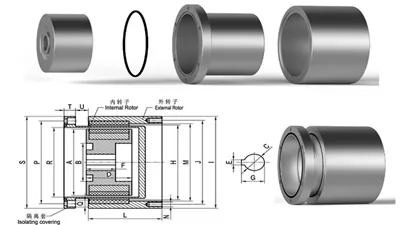
Magnetic coupling is a coupling that transfers torque from one shaft, but using a magnetic field rather than a physical mechanical connection.
Magnetic couplings are most often used for liquid pumps and propeller systems, since a static, physical barrier can be placed between the two shafts to separate the fluid from the motor operating in air. Magnetic couplings preclude the use of shaft seals, which eventually wear out and fail from the sliding of two surfaces against each another. Magnetic couplings are also used for ease of maintenance on systems that typically require precision alignment, when physical shaft couplings are used, since they allow a greater off axis error between the motor and driven shaft.
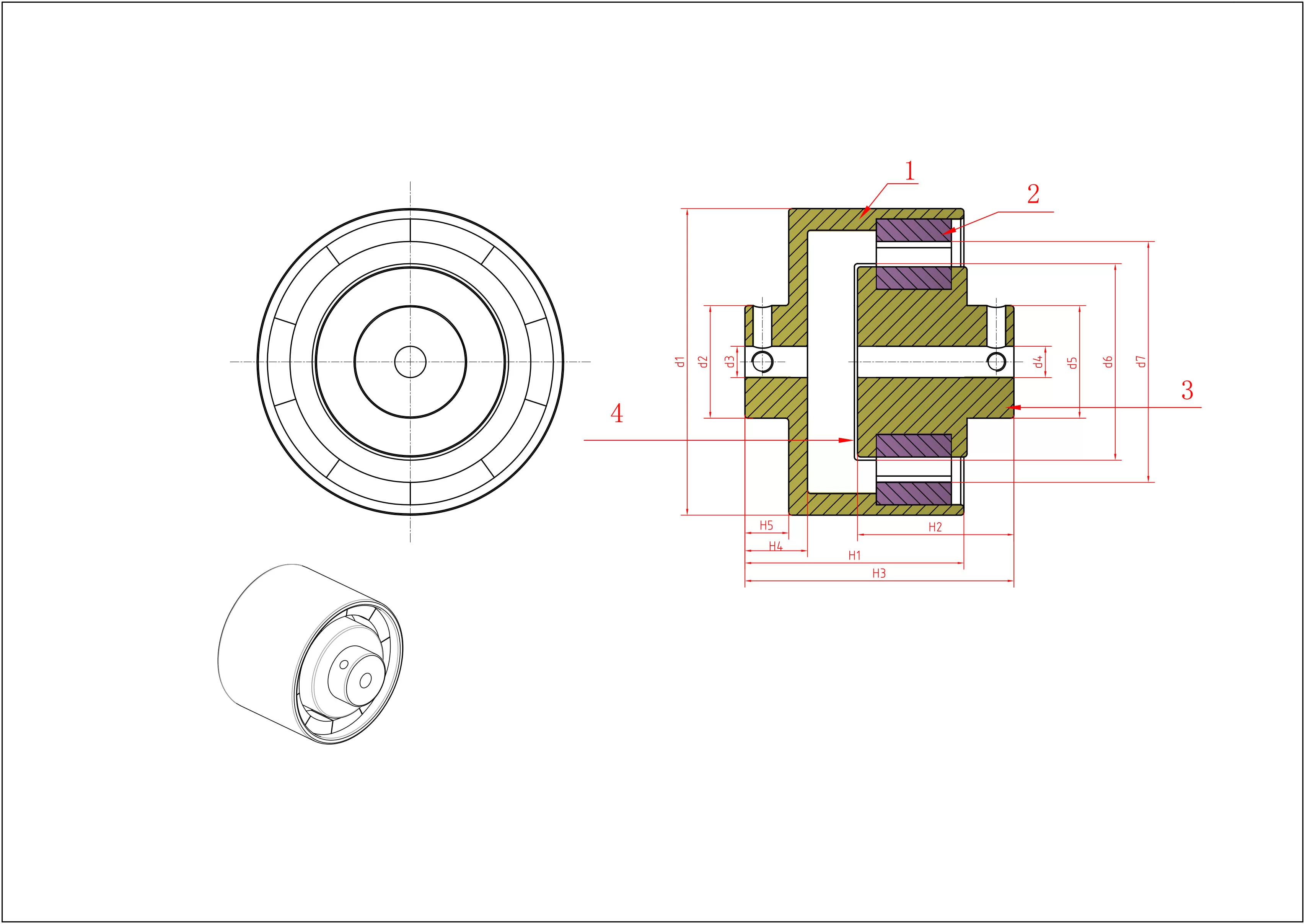
Item |
Description |
1 |
Outer Rotor |
2 |
Magnet |
3 |
Inner Rotor |
4 |
Spacer Sleeve |
A chemical pump moves acids, alkalis, solvents, hot hydrocarbons, or sterile intermediates. Every one of those fluids is a problem for a mechanical seal. The seal face wears, the seal needs flush water, the seal leaks at end-of-life, and the seal is the most common failure point in a centrifugal chemical pump. A magnetic coupling removes the seal from the equation entirely.
In a FAIZEAL magnetic coupling set, the drive shaft and the driven shaft are not physically connected. They are linked only by a magnetic field across the containment can. The can is the only physical barrier between the wet end and the dry end. The process fluid sees the can, the bearing housing, and the impeller — and nothing else. There is no seal face to wear, no flush plan to maintain, and no leak alarm to service. The pump runs for the life of the bearings.
For chemical service specifically, the materials matter as much as the principle. We select the can alloy (SS304 for general chemical, SS316 for chloride-bearing, SS316L for low-carbon sanitary), the hub steel (20# for cost-driven, martensitic SS for corrosion-driven), the magnet grade (N35-N52 for standard, SH/UH/EH for high-temperature), and the surface finish (black epoxy / polyester powder as the chemical-pump standard, with multi-layer stacks for halogen or hot-oil service) — all from a single material stack, on a single drawing tree.The inner rotor is mounted on the drive (motor) shaft, inside the containment can. The outer rotor is mounted on the driven (chemical-pump) shaft, outside the can. The can wall is the only physical barrier between the wet end and the dry end. Across that can wall, the inner rotor's rotating magnetic field synchronously locks the outer rotor's magnets into rotation. Torque crosses the can as a field, not as a force. This is the entire working principle of every magnetic coupling set, regardless of size or application.
The engineering decisions that matter are made before the first arc segment is ground:
• Pole-count parity: the outer rotor pole count must match the inner rotor pole count exactly. An 8-pole inner rotor needs an 8-pole outer rotor. Off-by-one or off-by-two poles is the most common reason a magnetic coupling set is short on torque
• Magnet grade parity: the outer rotor's magnet grade should match the inner rotor's. A N42 inner with a N35 outer will underperform, even though the magnets are made of the same family
• Air-gap budget: the gap between the magnet and the can is the single biggest variable in torque — we design the rotor and the can together to hit your actual gap, not a nominal zero
• Back-iron (hub) thickness: the hub behind the magnets is the rotor's back-iron. It must be thick enough not to saturate, and thin enough to keep the air gap small
• Eddy-current loss: high-rpm losses in the can are real; we spec the can wall material and thickness to keep total heating inside your service envelope
• Temperature stability: HcJ, urec, and irreversible loss budget computed for your max operating temperature, with margin for short-term excursions

The black epoxy / polyester powder coating is the most common surface finish for chemical-pump magnetic drive assemblies, and for good reason. A powder-coated finish on the rotor bodies, the outer cup, and the inner hub delivers a uniform 60-80 um dry-film thickness over every contour, including sharp edges, magnet pockets, and weld seams. It resists the splash zone around a chemical pump. It survives the wash-down cleaning of a chemical plant. It hides the inevitable scuffs and small scratches that come from years of service. And for hazardous-area ATEX service, the matte black finish reduces glare and visual signature inside the plant.
Beyond appearance, the black powder coat is a functional corrosion barrier. On a 20# carbon steel hub, the powder coat is the difference between a 5-year service life and a 1-year service life in a chloride-bearing plant. On a 316L sleeve, the powder coat is an additional layer of defense in case the sleeve passivation is ever compromised in service. We routinely run ASTM B117 salt-spray on coated hubs and sleeves; 500-1000 hours is the typical delivery spec, and multi-layer stacks (powder + primer + topcoat) can push that to 2000+ hours for the most aggressive chemical service.
The black finish is standard on this build. If your chemical service calls for a different color, a different resin system, or a different DFT, we run that too. Tell us your wash-down chemistry and your service environment; we will spec the coating.
A magnetic coupling set replaces the mechanical seal in a chemical pump. The reason to specify one is simple: the process fluid never touches a seal face. That single fact unlocks the rest of the benefit list.
• Hermetically sealed: there is no seal, no packing, no dynamic O-ring to wear. The only path from the wet end to the dry end is the can wall
• No contact of torque-transmitting elements: torque crosses the can as a magnetic field. No metal-to-metal contact between drive and driven side. No wear, no friction, no particle generation
• No maintenance necessary: no seal to replace, no flush plan to maintain, no leak alarm to service. Run the coupling for the life of the pump
• High-efficiency can optional: a thin-walled, low-electrical-loss can (Hastelloy, Inconel, titanium, or thin SS316L) reduces eddy-current heating at high speed and recovers torque capacity
• Synchronous torque transmission: zero slip across the can. The driven shaft tracks the drive shaft exactly. No torque ripple, no hunting, no heat from slip
• ATEX-ready construction: spark-safe materials and full certification pack available for Group II Category 2 / 3 hazardous areas
• Clean-room compatible: for semiconductor wet process and pharmaceutical API service
• Chemical industry: acid, alkali, solvent, and aggressive intermediate transfer; magnetic drive centrifugal pumps, sealless magnetic drive pumps
• Oil and gas industry: upstream produced water, amine and glycol service, offshore chemical injection, magnetic drive multiphase pumps
• Refining technology: hydrotreater charge pumps, hot-oil circulation, LPG / LNG handling, magnetic drive cryogenic pumps
• Pharmaceutical industry: API synthesis, sterile fluid transfer, biotech fermenters, sanitary centrifugal pumps
• Centrifugal pumps: canned motor pumps and standard magnetic drive pumps where a mechanical seal is the limiting component
• Top drive mixers and agitators: side-entry and top-entry mixers in reactors, crystallizers, and slurry tanks
• Food, beverage, and dairy: CIP-cleanable magnetic drive pumps for syrups, oils, and dairy transfer
• Semiconductor wet process: HF, SC1, SC2, NMP, IPA, Cu plating chemistries; clean-room assembled magnetic drive pumps
• Reverse-engineered replacements for legacy OEM couplings (Sundyne, Sundstrand, Magnatex, Tuthill, CECO, March, etc.)
If your process fluid must never touch a mechanical seal, this is the right component. Send us the fluid, the temperature, the duty, and the envelope — we will return a feasibility and indicative pricing note within 2 working days.
We do not outsource the steps that define your magnetic coupling set's performance:
• Sintered NdFeB (and SmCo) production, grain-boundary diffusion, and pulse magnetization through controlled, audited supply chains
• Multi-axis grinding of arc segments to +/-0.03 mm (precision +/-0.01 mm)
• CNC machining of inner / outer rotor hubs in 20# carbon steel, 17-4PH, 316L, 2205 duplex, 4140, titanium, Hastelloy, and Inconel — boring, key-cutting, magnet-pocket machining, balancing features
• Containment can forming and welding: deep-drawn SS304 / SS316 / SS316L cans; TIG, laser, and brazed seams with full-penetration weld verification; high-efficiency thin-wall cans in Hastelloy / Inconel / titanium
• Magnet pocket epoxy fill (potted construction)
• Black epoxy / polyester powder coating line: degrease, phosphate, rinse, dry, electrostatic powder spray, cure — 60-80 um DFT, ASTM B117 500-1000 hr typical
• 100% dynamic balance on in-house balancer to ISO 1940 G2.5 / G6.3 / G16
• Pulse magnetizer up to multi-Tesla, with field-mapping for Halbach and high-pole-count builds
• Full traceability: per-set batch record, magnet lot, sleeve material cert, balance report, coating test report, and optional magnetic flux map
All values are typical ranges — every parameter is customized on request.
Parameter / 参数 |
Typical Range / 典型范围 |
参数 |
典型范围 |
Magnet (Rotor Core) |
Sintered Neodymium-Iron-Boron (NdFeB); N35 / N38 / N42 / N48 / N50 / N52; SH / UH / EH |
永磁体(转子磁极) |
烧结钕铁硼(NdFeB);N35 / N38 / N42 / N48 / N50 / N52;SH / UH / EH |
Standard Pole Count |
8 poles (custom pole count available: 4 / 6 / 12 / 16 / 24 / 32) |
标准极对数 |
8 极(可定制 4 / 6 / 12 / 16 / 24 / 32 极) |
Sleeve / Containment Can |
Austenitic stainless steel: SS304 (standard chemical) / SS316 (chloride-bearing) / SS316L (low-carbon) |
隔离套(Can) |
奥氏体不锈钢:SS304(标准化工)/ SS316(含氯介质)/ SS316L(低碳) |
Main Body / Hub |
20# carbon steel (standard) or martensitic stainless steel (17-4PH / 410 / 420) |
主体(轮毂) |
20# 碳钢(标准)或马氏体不锈钢(17-4PH / 410 / 420) |
Standard Surface Finish |
Black epoxy / polyester powder coating, 60-80 um DFT; matte black appearance |
标准表面处理 |
黑色环氧/聚酯粉末涂层,60-80 um 干膜厚度;哑光黑外观 |
Optional Can Material |
High-efficiency can in Hastelloy C-276 / C-22, Inconel 625 / 825, or titanium Gr2 |
隔离套可选材质 |
高效 can 可选 Hastelloy C-276 / C-22、Inconel 625 / 825、钛 Gr2 |
Outer Diameter Range |
Ø30 mm - Ø800 mm+ (no upper limit) |
外径范围 |
Ø30 mm - Ø800 mm+(无上限) |
Axial Length |
15 mm - 300 mm |
轴向长度 |
15 mm - 300 mm |
Shaft Bore |
Customer-specified: press-fit, keyed (DIN 6885 / ANSI B17.1), splined, threaded, or proprietary lock |
轴孔 |
按客户指定:压配、键槽(DIN 6885 / ANSI B17.1)、花键、螺纹或非标锁紧 |
Magnet Circuit |
Radial multi-pole; Halbach optional (single / dual layer) |
磁路形式 |
径向多极;Halbach 可选(单层/双层) |
Balance Grade |
G2.5 / G6.3 / G16 per ISO 1940 |
动平衡 |
G2.5 / G6.3 / G16(按 ISO 1940) |
Working Temperature |
-40 C to +80 C (N-grade NdFeB); up to +200 C (EH) / +350 C (SmCo optional) |
工作温度 |
-40 C 至 +80 C(N 级 NdFeB);+200 C(EH)/ +350 C(可选 SmCo) |
Can-Side Pressure |
Up to 100 bar (geometry dependent; high-efficiency can rated higher) |
隔离套承压 |
最高 100 bar(取决于几何;高效 can 可更高) |
Coating Salt-Spray Resistance |
ASTM B117: 500-1000 hrs typical (black epoxy / polyester powder); higher with multi-layer stack |
涂层盐雾 |
ASTM B117:500-1000 小时典型(黑环氧/聚酯粉末);多层叠加可更高 |
Torque Transmission |
Synchronous (zero slip) — torque crosses the can without mechanical contact |
扭矩传递 |
同步(零滑差)——扭矩穿过隔离套零接触传递 |
Maintenance |
None required — no wearing parts, no seal to replace, no bearing-to-fluid contact |
维护 |
免维护——无易损件、无密封件更换、轴承不接触工艺介质 |
Sealing Class |
Hermetically sealed assembly; can-side option for full CIP / SIP compatibility |
密封等级 |
整体气密封;隔离套侧可全 CIP / SIP 兼容 |
A magnetic coupling set is a pair of permanent-magnet rotors — an inner rotor and an outer rotor — separated by a non-magnetic containment can. The inner rotor is mounted on the drive (motor) shaft, the outer rotor is mounted on the driven (chemical-pump) shaft, and the can is fixed to the pump housing. The inner rotor's rotating magnetic field crosses the can wall and synchronously locks the outer rotor's magnets into rotation. Torque is transmitted without any mechanical contact across the can, so the process fluid never touches a seal. The set is fully hermetically sealed, maintenance-free, and synchronous (zero slip).
The standard build uses sintered Neodymium-Iron-Boron (NdFeB) magnets, an austenitic stainless steel sleeve / containment can (SS304, SS316, or SS316L low-carbon), and a 20# carbon steel main body / hub. Martensitic stainless steel (17-4PH, 410, 420) is used for the hub when corrosion resistance matters more than the last few percent of magnetic saturation. The can can be upgraded to a high-efficiency thin-wall build in Hastelloy C-276 / C-22, Inconel 625 / 825, or titanium Gr2 for halogen, hot-oil, and cryogenic service. The standard surface finish is a black epoxy / polyester powder coating, 60-80 um DFT, ASTM B117 500-1000 hours. We do not ship magnetic coupling sets with unspecified materials — every alloy, every grade, and every certificate is on the BOM.
Black epoxy / polyester powder coating is the chemical-pump industry standard. It delivers a uniform 60-80 um dry-film thickness over every contour, including sharp edges, magnet pockets, and weld seams. It resists the splash zone around a chemical pump, survives the wash-down cleaning of a chemical plant, hides the scuffs and small scratches of years of service, and reduces glare in hazardous-area ATEX plants. Beyond appearance, the powder coat is a functional corrosion barrier — on a 20# carbon steel hub, the powder coat is the difference between a 5-year and a 1-year service life in a chloride-bearing plant. We can run multi-layer stacks (primer + powder + topcoat) for 2000+ hour ASTM B117 salt-spray in the most aggressive chemical service.
A mechanical seal pump transmits torque through a spring-loaded seal face that slides against a stationary face. That face wears, it needs flush, it leaks at end-of-life, and it is the most common failure point in a centrifugal chemical pump. A magnetic coupling replaces the seal entirely. The drive shaft and the driven shaft are not physically connected — they are connected only by a magnetic field across the can wall. There is nothing to wear, nothing to flush, and nothing to leak. The wet end of the pump is hermetically sealed from the dry end for the life of the coupling.
The can is the static, non-magnetic wall that separates the inner rotor (dry side, motor) from the outer rotor (wet side, chemical pump). It is the only physical barrier between the process fluid and the drive side. The can is the most safety-critical component of the set. We form it from austenitic stainless steel (SS304 / SS316 / SS316L) as standard, and from Hastelloy, Inconel, or titanium for halogen, hot-oil, and cryogenic service. The can wall is thin to minimize eddy-current loss, but it is engineered to your pressure rating. Tell us your service pressure; we will spec the can wall.
A high-efficiency can is a thin-walled can, typically in Hastelloy C-276 / C-22, Inconel 625 / 825, or titanium Gr2, that reduces eddy-current loss at high operating speed. A thicker SS316 can dissipates more heat at high rpm; a thin-wall high-efficiency can keeps the temperature down and recovers torque capacity. The trade-off is pressure rating — a thin-wall can is rated for a lower can-side pressure than a thicker SS316 can. We will spec the can to your pressure and your speed envelope together.
Magnetic coupling sets are used for any fluid that cannot be allowed to leak — acids, alkalis, solvents, hydrocarbons, hot oils, cryogenic liquids, sterile fluids, slurries, and high-purity chemicals. Standard applications include chemical industry, oil and gas, refining, pharmaceutical, centrifugal pumps, and top drive mixers / agitators. If your fluid is halogenated, hot, oxidizing, cryogenic, or sterile, we have a can and a hub material for it. Send us the fluid name and the operating temperature; we will return a recommended material stack within 2 working days.
Yes. There are no wearing parts in the coupling itself. No seal face to replace, no flush plan to maintain, no dynamic O-ring to service. The bearings are sized to your service speed and your environment, and are the only consumable in the magnetic drive assembly. The standard bearing life on a correctly specified magnetic drive chemical pump is the same as the bearing life on a mechanical-seal chemical pump — but without the seal failure risk. In practice, a magnetic drive chemical pump typically runs for 5-10+ years between bearing services.
Yes. The torque direction is determined by the magnetization direction of the magnets. We can build a set for any drive direction, and we can build a bidirectional set if your application requires it. Tell us the rotation direction (CW / CCW viewed from the motor) at quotation, and we will lock the magnetization direction into the BOM.
Yes. Send us the OEM model number, the existing set OD / ID / length, and (if you have it) the magnet grade and pole count. We will back-propose a drop-in replacement, including a magnetic circuit spec and a balanced matched set if you need both halves. We have reverse-engineered Sundyne, Sundstrand, Magnatex, Tuthill, CECO, March, and other legacy OEM couplings for chemical-pump service.
The outer rotor's inner diameter defines the can's outer diameter (plus a small clearance). The can's inner diameter defines the inner rotor's outer diameter. The three components — inner rotor, can, outer rotor — share one air-gap stack. We engineer the full stack in-house; you get a single circuit-spec, not three independent supplier drawings. The inner rotor and the outer rotor are balanced and shipped as a matched pair; the can is supplied to your drawing or to FAIZEAL's, per your preference.
The can body is designed to the pressure rating you specify. We have delivered can-side ratings up to 100 bar (with thicker SS316 cans) and higher-pressure service with high-efficiency thin-wall cans, geometry dependent. Tell us the service pressure and we will spec the can wall material and thickness. We will also run a full-penetration weld verification on every can we form.
We supply ATEX / IECEx-ready construction (spark-safe materials, certified material certificates) and the full documentation pack. The matte black powder-coat finish is preferred in many ATEX plants for its low-glare profile. We are not a notified certification body, but we provide the engineering record and test data your notified body requires. We have shipped ATEX Group II Category 2 / 3 certified magnetic drive chemical pumps and magnetic coupling sets for offshore and chemical service.
Prototype / sample magnetic coupling set: 10-20 working days after drawing freeze. Production: 20-45 working days depending on volume, material, and can construction. High-efficiency thin-wall can and Halbach orders may run longer — we confirm a date at quotation. Repeat orders from a frozen design typically ship in 15-30 working days.
We typically return a feasibility and indicative pricing note within 2 working days, and a firm quotation within 5-7 working days.
FAIZEAL — custom magnetic coupling sets for chemical pumps, black-painted, hermetically sealed, material-engineered, built to your drawing.


