
+86-574-87520996
sales@fzmag.com

The W Series are cylindrical one-piece magnetic wheels, powered by high-performance NdFeB permanent magnets. Designed as drop-in drive or idler wheels for wheeled wall-climbing robots. The bore follows H7 tolerance class with a standard keyway for secure shaft connection. Nine sizes from Ø25 to Ø160mm cover light-duty inspection robots to heavy industrial climbers.
NdFeB permanent magnets: High coercivity, high remanence — maximum magnetic energy in minimum weight
H7 bore tolerance: Precision fit with standard transmission shafts, keyway prevents slip
Weight-optimized options: FZW80 and above available in reduced-mass versions without compromising adhesion
One-piece enclosed design: Fully encapsulated magnetic circuit — no exposed magnets, safe and contamination-resistant
F = Force (N)
W_workpiece = Workpiece Weight (kg)
W_shaft = Shaft Weight (kg)
T = Torque (Nm)
F = Force (N)
D = Wheel Diameter (m)
η = Transmission Efficiency (dimensionless, between 0 and 1)
SF = Safety Factor (dimensionless)

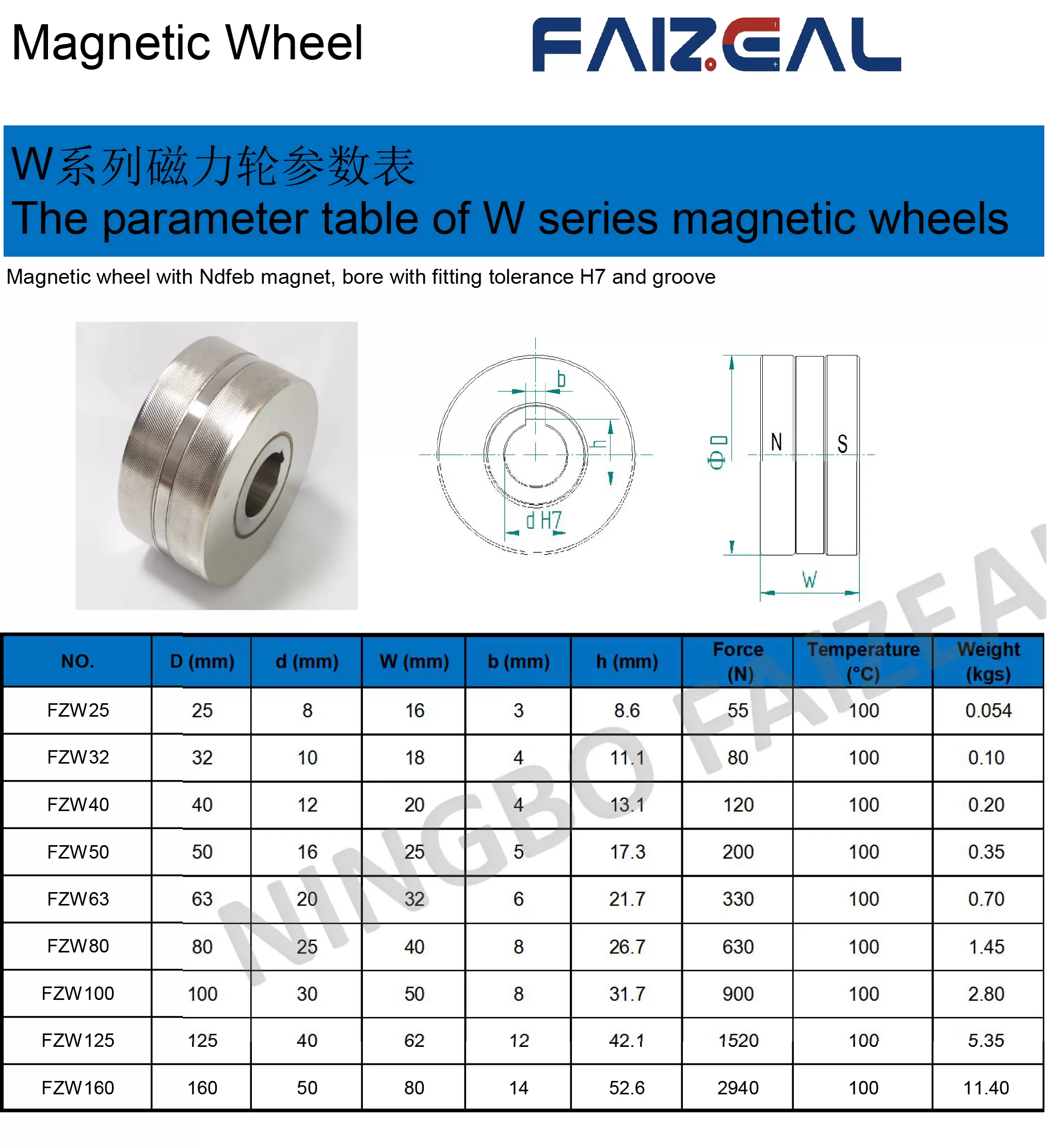
Note: Adhesion values are measured on polished S235JR carbon steel (≥10mm thickness) at room temperature. Actual adhesion is affected by substrate material, surface condition, temperature, and installation preload. Consult our engineers before finalizing selection.
Storage tank and pressure vessel inspection robots
Large-diameter pipeline external inspection robots
Wind turbine tower and nacelle surface robots
Ship hull and offshore structure inspection robots
Steel structure weld NDT and derusting robots
| Criteria | W Series Magnetic Wheels | R Series Magnetic Segments |
|---|---|---|
| Form Factor | Cylindrical one-piece wheel | Arc segment, stainless steel frame |
| Mounting | H7 bore + keyway, shaft-fit | M4/M5/M6 threaded holes, flange-mount |
| Best For | Direct drive/idler wheels | Multi-segment large-diameter wheel groups |
| Size Range | Ø25–Ø160mm | R50–R150, multiple lengths |
| Max Adhesion | 2940N (FZW160) | 4850N (FZR150120 @ 0mm gap) |
| Gap Adaptation | Single rated value | 0 3 5mm clearance options |
| Typical Robots | Small-to-medium inspection & NDT | Large heavy-duty operation robots |
Stated adhesion values are measured under standard conditions (polished S235JR carbon steel, ≥10mm thickness, room temperature). Actual adhesion in the field is significantly affected by:
Substrate material (carbon steel stainless steel aluminum alloy) and surface roughness
Plate thickness (thinner plates reduce adhesion)
Installation preload and robot weight distribution
Operating temperature (NdFeB max operating temperature ≤100°C)
Surface coatings (paint, rust, scale) thickness
Selection Support: Please share your robot specifications — weight, working posture, target substrate, and surface conditions — with our engineering team before finalizing your order.