Principles and Applications of Magnetic Wheels for Wall-Climbing Robots
FAIZEAL — Wall-Climbing Robot Magnetic Wheel Guide
Wall-Climbing Robot Magnetic Wheel — Operating Principle and Full-Spectrum Customization Guide
Permanent Magnet Adhesion Wheel — Complete Engineering Documentation for Climbing Robots in Marine, Wind Power, Storage Tank, and Steel Structure Applications
magnetic wheel / wall-climbing robot magnetic wheel / permanent magnet adhesion wheel / magnetic crawler wheel / tile-type magnetic wheel / cylindrical magnetic wheel / arc-shaped magnetic wheel / NdFeB magnetic wheel / magnetic wheel manufacturer / magnetic wheel supplier / magnetic wheel OEM / magnetic wheel custom / ship hull cleaning robot / wind tower inspection robot / storage tank inspection robot / magnetic adhesion / permanent magnet climbing wheel / magnetic wheel IP68 / magnetic wheel explosion proof
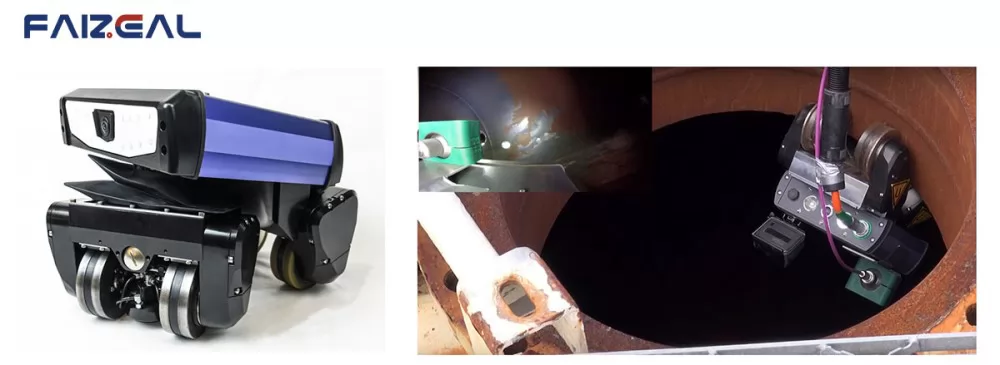
1. Introduction — Wall-Climbing Robot Magnetic Wheel: The Core Actuator for Iron-Surface High-Altitude Operations
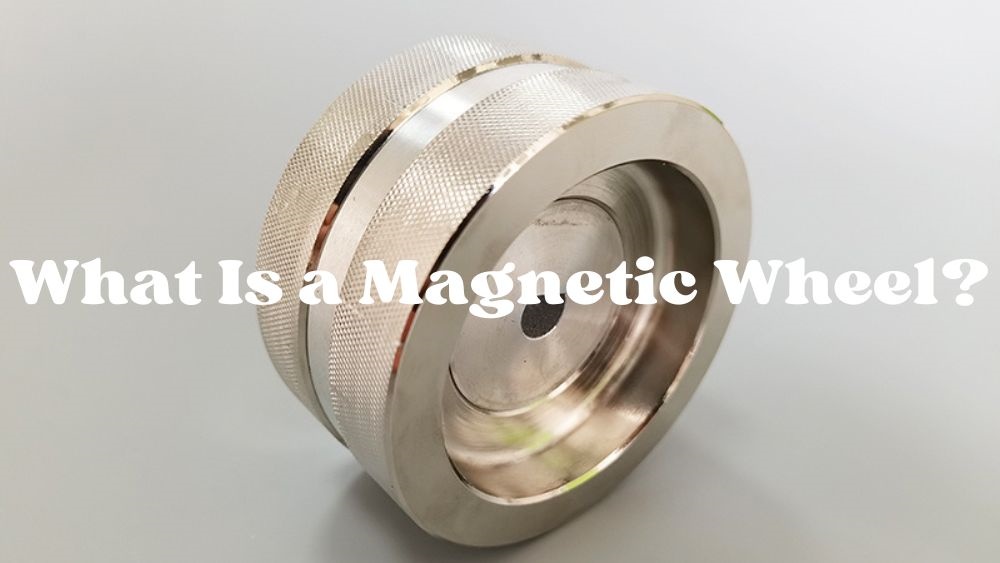
The wall-climbing robot magnetic wheel, also known as the permanent magnet adhesion wheel, magnetic crawler wheel, magnetic drive wheel, magnetic climbing wheel, or permanent magnet crawling wheel, is the most critical actuator component in modern industrial climbing robot systems. It is widely used in wind tower inspection robots, ship hull rust removal robots, large storage tank inner wall inspection robots, steel structure bridge inspection robots, nuclear reactor pressure vessel inspection robots, offshore platform operation robots, high-rise building exterior wall cleaning robots, and explosion-proof climbing operation robots.
As a neodymium iron boron magnet assembly manufacturer with 15 years of specialization, FAIZEAL has long provided global B2B customers with full-spectrum custom services ranging from Ø25 miniature magnetic wheels to R100 arc-shaped tile-type magnetic wheels, with monthly production capacity exceeding 10,000 units. FAIZEAL magnetic wheels have been widely applied in high-end industrial scenarios including ship rust removal, wind power operation and maintenance, storage tank inspection, bridge inspection, and nuclear reactor pressure vessel inspection.
The core value of the magnetic wheel is that through the adhesion force between sintered NdFeB (or SmCo) permanent magnets and ferromagnetic surfaces, the climbing robot can stably adhere to any ferromagnetic surface in vertical, inverted, or ceiling orientations, while maintaining sufficient friction force to propel the robot forward. This technology completely solves three major problems facing traditional high-altitude operations (scaffolding, gondolas, ropes): high safety risk to personnel, low per-capita operation efficiency, and high comprehensive operation cost.
This engineering guide systematically describes the operating principle of the magnetic wheel, the core engineering equations, the overall construction, the two main configurations (cylindrical + tile-type arc), the core advantages, the key application industries, the full-spectrum customization capabilities, and reserves space for displaying FAIZEAL's historical custom case projects. This guide is intended for wall-climbing robot system integrators, wind power operation and maintenance engineers, ship maintenance engineers, storage tank inspection engineers, steel structure inspection engineers, explosion-proof climbing engineers, and technical procurement specialists.
2. Operating Principle — Coupling of Permanent Magnet Adhesion and Friction Propulsion
The core operating principle of the magnetic wheel is based on the coupling of two independent physical processes:
First Process: Magnetic Adhesion — The sintered NdFeB (or SmCo) permanent magnet generates a constant magnetic field, which crosses the air gap (typically 0.1-1.0 mm) to reach the ferromagnetic surface (steel, cast iron, iron-nickel alloy), inducing mirror magnetic poles on the ferromagnetic surface, thereby producing a normal adhesion force perpendicular to the surface. The adhesion force magnitude depends on the air-gap magnetic flux density B_g, the effective air-gap area A, and the magnetic permeability of the ferromagnetic material.
Second Process: Friction Propulsion — The climbing robot's drive motor drives the magnetic wheel to rotate through the reducer and drive shaft, and the static friction force (μ × F_magnetic) between the magnetic wheel and the ferromagnetic surface provides the horizontal propulsion traction. When the traction is greater than or equal to the sum of the robot's gravity component, wind load resistance, and inertial force, the robot walks stably on the vertical or inverted surface.
The coordination of these two processes enables the climbing robot to stably adhere and freely walk on various ferromagnetic surfaces:
• Vertical walls: ship hull, storage tank side walls, wind tower cylinders
• Inverted ceilings: ship bottoms, bridge undersides, tank top covers
• Inclined surfaces: inclined steel structures, pipe outer walls
• Curved surfaces: cylinders, spherical tanks, pipes
The magnetic wheel can be used alone (single-wheel robot), combined in multi-wheel arrays (four-wheel or eight-wheel tracked robots), or combined with other adhesion methods such as vacuum suction and thrust jetting to form a composite adhesion system.
3. Core Engineering Equations — Quantitative Calculation of Adhesion Force, Torque, and Power
3.1 Maxwell Magnetic Adhesion Force
The normal magnetic adhesion force between the magnetic wheel and the ferromagnetic surface is given by the Maxwell stress tensor:
F_m = (B_g² × A) / (2μ₀)
where F_m is the normal adhesion force (N), B_g is the air-gap magnetic flux density (T), A is the effective contact area (m²), and μ₀ is the permeability of free space (μ₀ = 4π × 10⁻⁷ H/m).
For a typical NdFeB N52 magnetic wheel (B_g = 0.4-0.6 T), each square centimeter of contact area produces 64-145 N of adhesion force. For a tile-type magnetic wheel (contact area 100-200 cm²), the single-wheel adhesion force can reach 6400-29000 N.
3.2 Maxwell Magnetic Pressure
The normal adhesion force per unit area is defined as magnetic pressure:
p_m = F_m / A = B_g² / (2μ₀)
When B_g = 0.5 T, p_m ≈ 99.5 kPa ≈ 1 atm; when B_g = 0.7 T, p_m ≈ 195 kPa ≈ 2 atm. This is the core quantitative indicator for magnetic wheel design, directly determining the optimization direction of the magnetic circuit design, magnet grade, and pole piece geometry.
3.3 Friction Traction Force
The horizontal traction force required for the climbing robot's propulsion is given by Coulomb's friction law:
F_traction = μ × F_normal = μ × (F_m + F_aux)
where μ is the static friction coefficient between the magnetic wheel surface and the ferromagnetic surface (steel-to-steel approximately 0.4-0.6, up to 0.7-0.9 with friction liner), F_m is the magnetic adhesion force, and F_aux is the auxiliary pressing force (the normal component of the robot's weight on the wall + the normal component of the wind load).
3.4 Single Wheel Load Capacity
The maximum load capacity of a single magnetic wheel (including safety factor):
W_max = (μ × F_m) / SF = (μ × B_g² × A) / (2μ₀ × SF)
where SF is the safety factor (typically 2-4, climbing robot SF ≥ 3 to ensure absolute safety on inverted surface adhesion). The total load capacity of a multi-wheel robot = ΣW_max × n_wheels.
3.5 Driving Torque
The torque required to drive the magnetic wheel of the climbing robot:
T_drive = (m × g × r × sin θ + F_drag × r) / η_gear
where m is the total robot mass, g is the gravitational acceleration, r is the magnetic wheel radius, θ is the angle between the wall and horizontal (θ = 90° for vertical wall), F_drag is the wind resistance or medium drag, and η_gear is the reducer efficiency.
3.6 Climbing Power
The motor power required for the climbing robot's stable walking:
P_climb = (m × g × v × sin θ + F_drag × v) / η_total
where v is the walking speed, and η_total is the total transmission efficiency (typically 0.6-0.85).
3.7 Eddy Current Loss
When the magnetic wheel rolls on the ferromagnetic surface, the permanent magnet magnetic field induces eddy currents in the ferromagnetic body (conductor), generating heat:
P_e = k_e × (π × f × B_g)² × t² × V / ρ
where f is the magnetic field alternating frequency (related to rotational speed and pole count), t is the ferromagnetic wall thickness, V is the ferromagnetic effective volume, and ρ is the ferromagnetic electrical resistivity. This is the main heat source for high-speed magnetic wheels and must be strictly controlled in high-speed magnetic wheel design.
3.8 Wheel Service Life
The service life of the magnetic wheel under rated load is influenced by three factors: magnet demagnetization, bearing wear, and surface wear:
L_wheel = min(L_demag, L_bearing, L_surface)
where L_demag is the demagnetization life (theoretically infinite for NdFeB and SmCo, slightly lower for bonded NdFeB), L_bearing is the bearing life (L10 = 10,000-50,000 h), and L_surface is the surface wear life (related to contact area and walking distance).
4. Overall Construction — Four Core Components
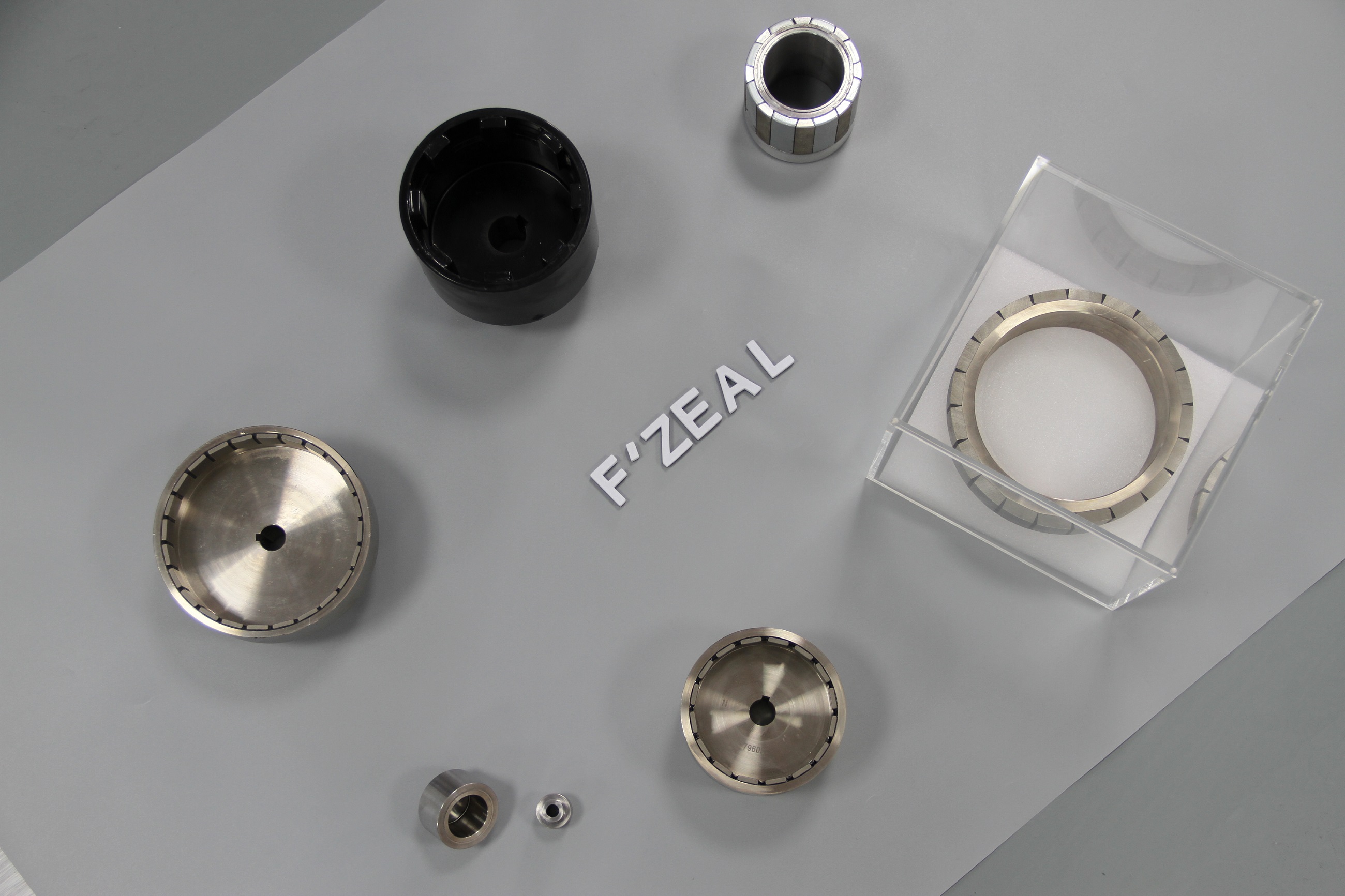
According to FAIZEAL's engineering drawings and physical product images, each magnetic wheel is composed of the following four core components (taking the tile-type magnetic wheel engineering drawing labels 1-2-3-4 as an example):
4.1 Permanent Magnet — Component 1
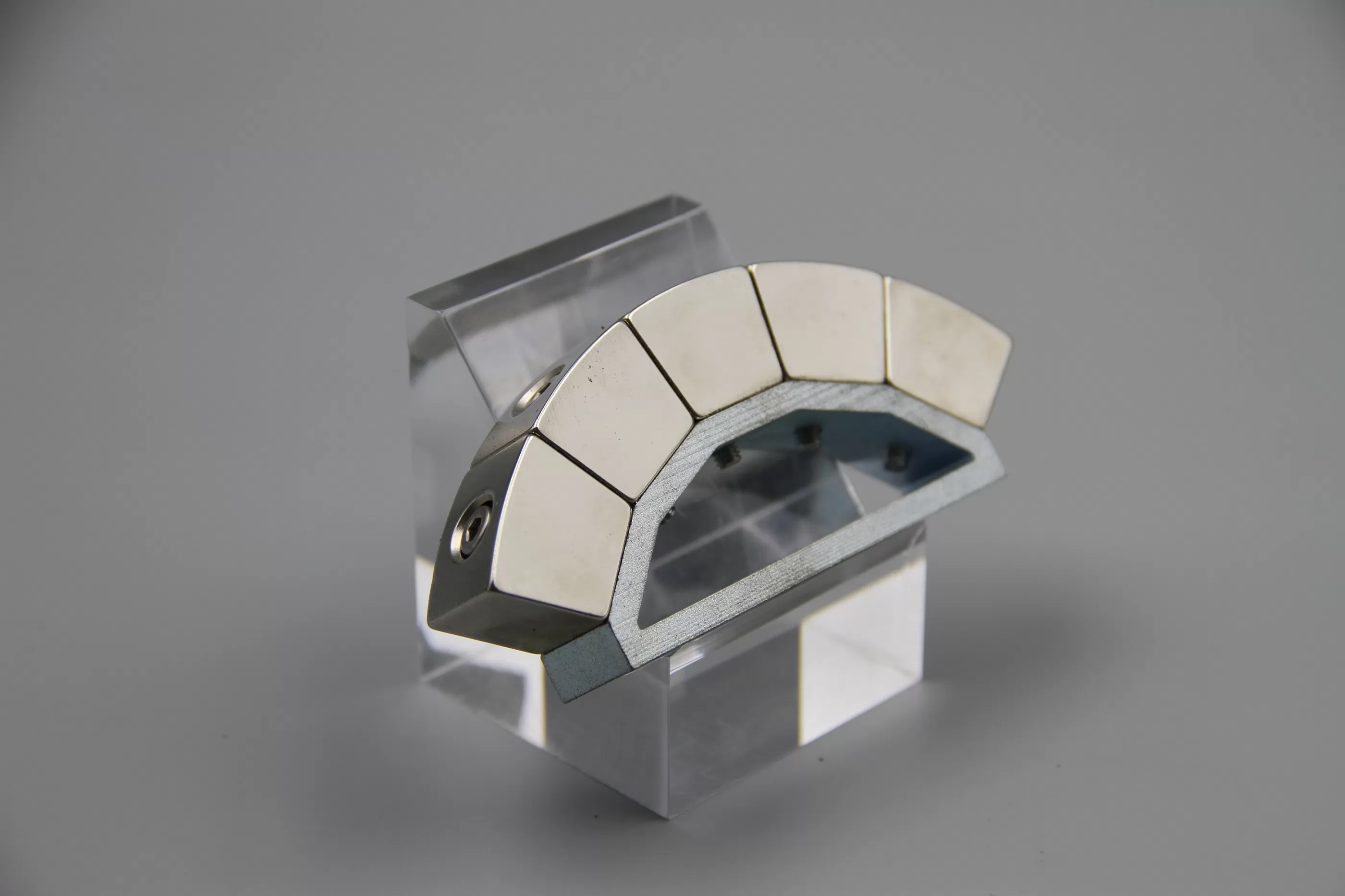
The magnetic field source of the magnetic wheel, typically a ring-shaped sintered NdFeB (most common) or SmCo. FAIZEAL provides full-spectrum grades including N35-N52 (room temperature), N42SH/N40UH (≤180°C), and N38EH/N35AH (≤200°C). The permanent magnet is magnetized radially or along the arc direction, with Ni-Cu-Ni three-layer plating on the surface for corrosion protection. For tile-type magnetic wheels, the magnet is assembled from multiple arc-shaped magnet segments (typically 8-16 segments).
4.2 Pole Piece — Component 2
The pole piece is a soft magnetic material (usually 10# low-carbon steel or DT4 electrical pure iron) closely attached to both ends of the permanent magnet, functioning to conduct magnetic flux, concentrate magnetic flux, and protect the magnet. The geometric shape of the pole piece directly determines the magnetic field distribution and adhesion force curve of the magnetic wheel. The pole piece of the tile-type magnetic wheel adopts an arc design, perfectly matching the magnet arc surface.
4.3 Housing — Component 3 + Component 4
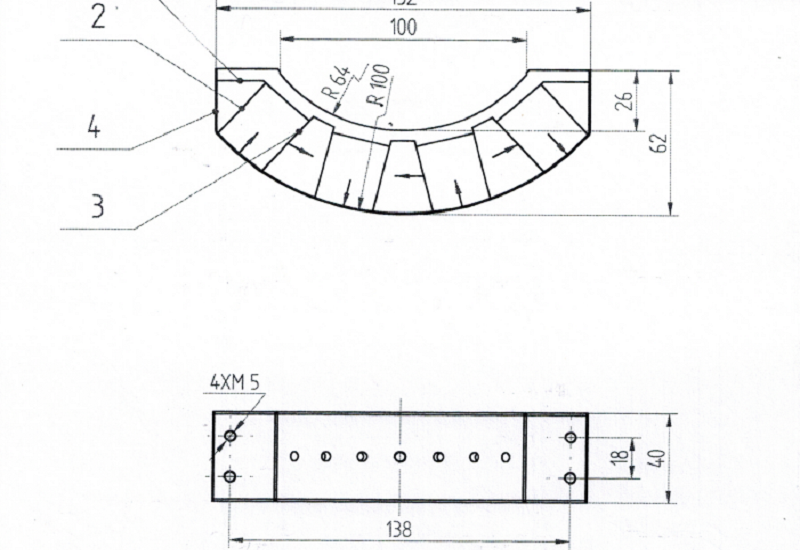
The housing is the mechanical load-bearing structure of the magnetic wheel, providing multiple installation interfaces such as keyway, interference fit, threaded bore, and flange. The housing material is low-carbon steel (complete magnetic circuit) or stainless steel (non-magnetic isolation ring, partially used for sealed magnetic wheels). The tile-type magnetic wheel housing includes 4×M5 main mounting holes + 8 auxiliary fastening holes, facilitating multi-wheel assembly and stable installation.
4.4 Bearing / Shaft Bore
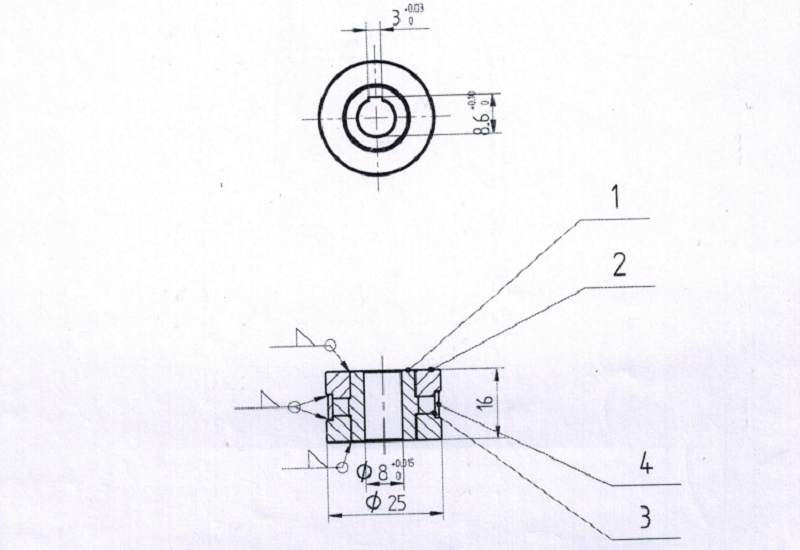
The magnetic wheel connects to the drive shaft through keyway, interference fit, threaded bore, flange mount, or other interfaces. FAIZEAL's standard keyway specifications as shown in the cylindrical magnetic wheel engineering drawing: key width 3 mm, key depth Ø8.6 mm, matching shaft bore Ø8 H7 (+0.015/0), total outer diameter Ø25 mm, total width 16 mm.
5. Two Main Configurations — Cylindrical vs Tile-Type Magnetic Wheel
FAIZEAL provides two main series of magnetic wheels targeting different application scenarios:
5.1 Cylindrical Magnetic Wheel
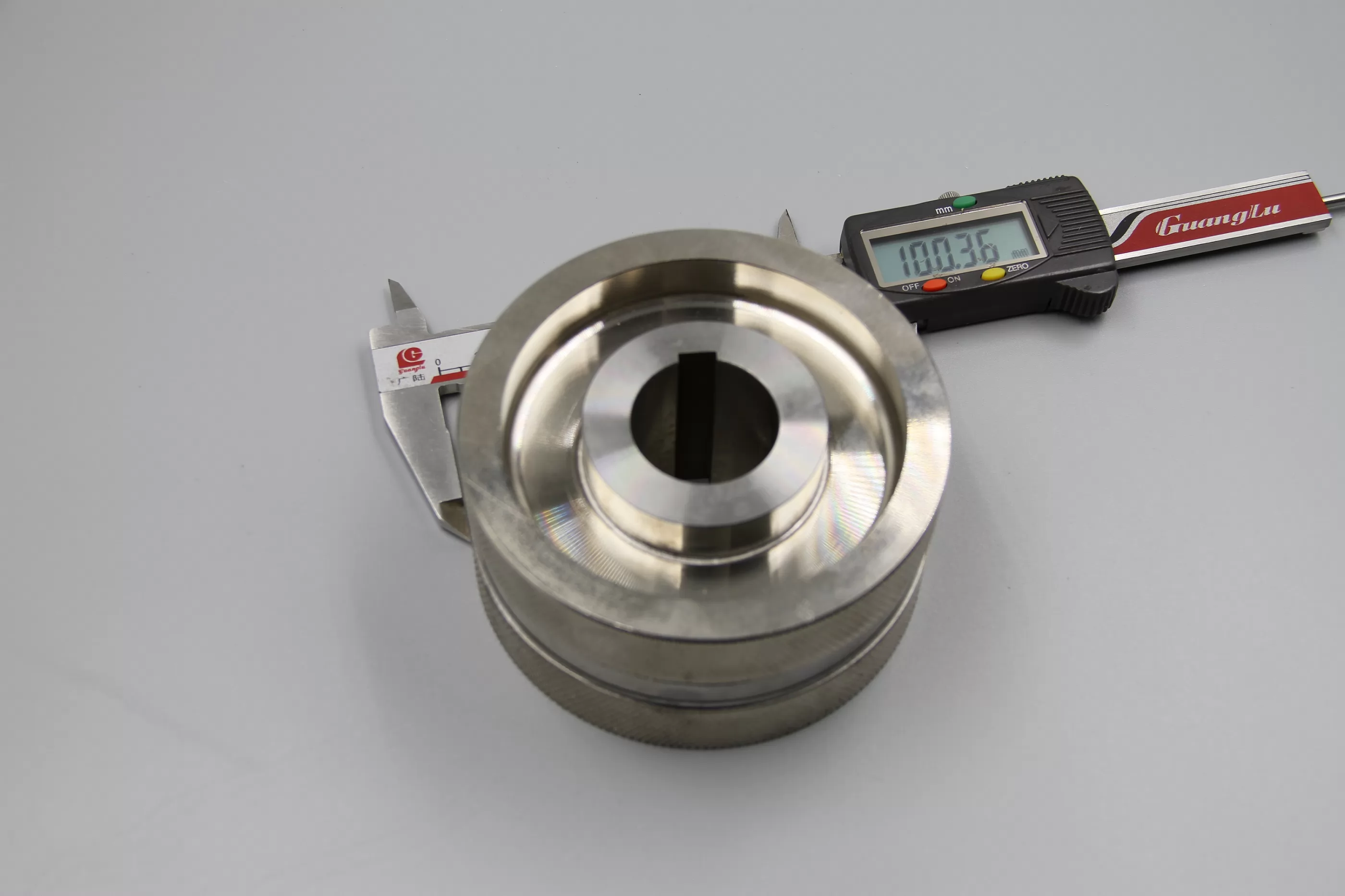
The cylindrical magnetic wheel is FAIZEAL's most classic product series, adopting a standard circular magnetic circuit structure. As shown in the physical product image at the top of this guide, FAIZEAL provides cylindrical magnetic wheels in multiple sizes from Ø25 miniature to Ø80+ large, including:
• Miniature Ø25 series: 16 mm width, keyway 3×Ø8.6 mm, key bore Ø8 H7 (engineering drawing specifications in figure)
• Medium Ø40-50 series: 20-30 mm width, flange or keyway interface
• Large Ø80+ series: 30-50 mm width, heavy-duty design
Advantages of cylindrical magnetic wheel: compact structure, high rotational speed, easy to arrange on tracked or wheeled walking mechanisms. Suitable for storage tank inner walls, wind tower cylinder inner walls, pipe inner walls, narrow space inspection and other applications.
5.2 Tile-Type Arc Magnetic Wheel
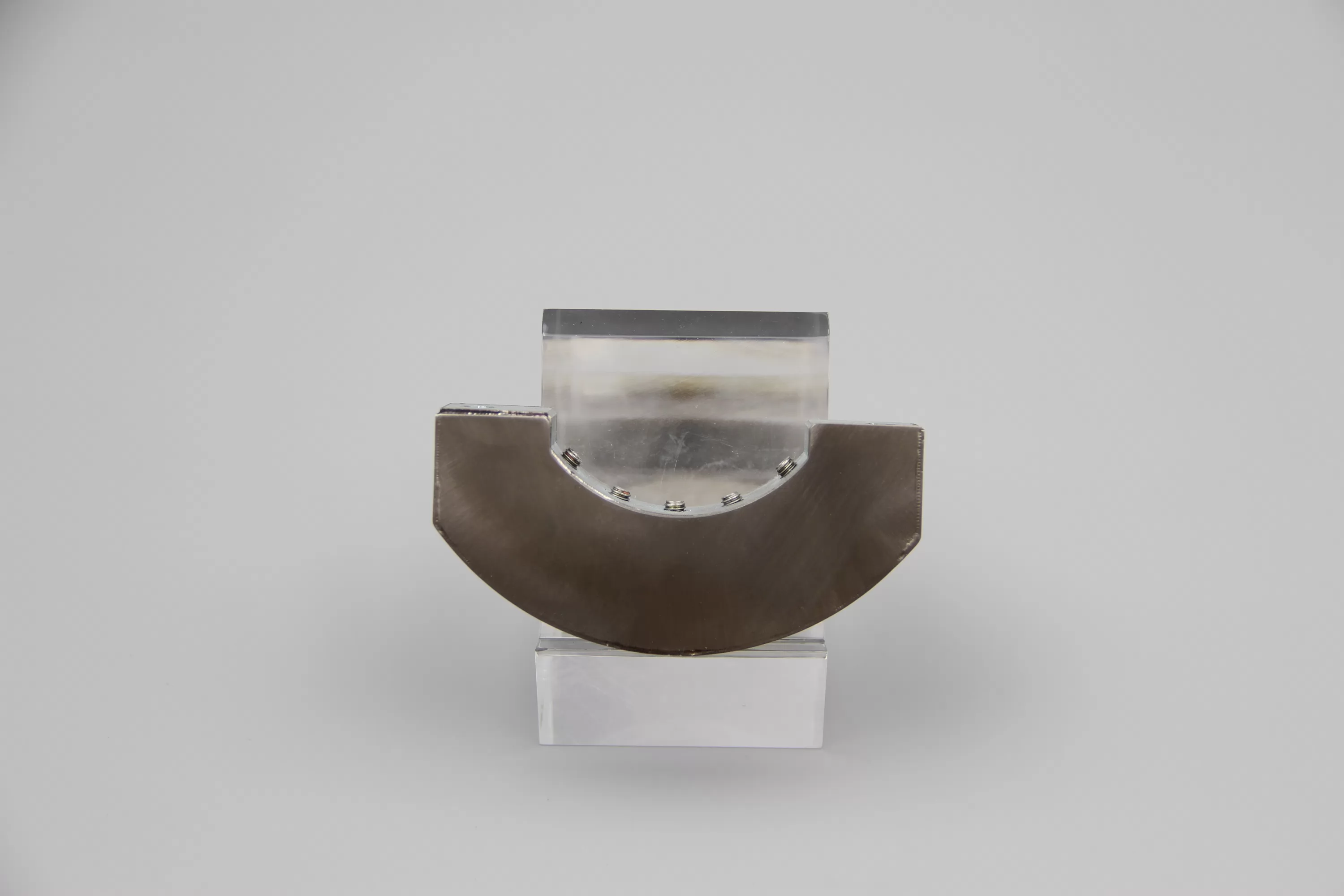
The tile-type magnetic wheel (also known as the arc-shaped magnetic wheel or tile-shaped magnetic wheel) is a special configuration designed by FAIZEAL for large curved ferromagnetic surfaces. The detailed specifications are visible from the provided engineering drawing:
• Arc curvature: R64 (inner arc) — R100 (outer arc), corresponding arc length approximately 152 mm
• Bottom dimensions: 138 × 40 mm, with 4×M5 main mounting holes + 8 auxiliary fastening holes
• Total height: 62 mm (of which 26 mm is magnet thickness, 36 mm is steel back-yoke)
• Adhesion surface: arc-shaped R64-R100 surface, large single-wheel adhesion area
Advantages of tile-type magnetic wheel:
• Large contact area: single tile-type wheel adhesion force can reach thousands of newtons, far exceeding cylindrical
• Arc matching: perfectly fits large arc surfaces such as wind tower cylinders, storage tank side walls, ship hulls
• High load capacity: single wheel can carry 50-500 kg, suitable for carrying large operation modules (cleaning, spraying, inspection, welding)
• Modular design: 4×M5 mounting holes facilitate multi-wheel assembly into large magnetic adhesion arrays
5.3 Configuration Selection Decision
• Cylindrical: narrow spaces, pipe inner walls, tank inner walls, light-load inspection
• Tile-type: large arc surfaces, wind tower cylinders, tank outer walls, ship hulls, large operation modules
Customers can freely select based on the specific application scenario (curvature radius, load size, installation space). FAIZEAL's engineering team can assist customers with configuration selection and solution design.
6. Why Use Magnetic Wheels — Seven Core Advantages
6.1 Zero-Power Adhesion
The magnetic wheel uses permanent magnet adhesion without any electric energy to maintain adhesion. Even during power failure, the robot remains firmly adhered to the ferromagnetic surface, providing zero-power + fail-safe performance. This is a core advantage unattainable by electromagnet adhesion solutions — the electromagnet adhesion solution requires continuous power supply to maintain adhesion, and the robot falls immediately once power is lost.
6.2 High Load Capacity
A single tile-type magnetic wheel can provide thousands of newtons of adhesion force, sufficient to carry 50-500 kg operation modules (cleaning head, inspection instrument, spraying arm, welding gun). Multi-wheel combination can achieve multi-ton load capacity. FAIZEAL's tile-type magnetic wheels have been successfully applied in multi-ton climbing robot systems.
6.3 Any-Pose Adhesion
The magnetic wheel maintains stable adhesion in vertical, inverted, inclined, curved, and various other poses. This is the most core requirement for high-altitude operation robots — traditional scaffolding and gondolas can only operate in specific poses, while the magnetic wheel + climbing robot can stably operate in any pose.
6.4 Rolling Friction
The interface between the magnetic wheel and the ferromagnetic surface is rolling friction, with a friction coefficient far less than sliding friction. This delivers three major advantages:
• Low walking resistance (low motor power demand)
• Low surface wear (does not damage the inspected surface)
• Smooth walking (no impact vibration)
6.5 Wind and Vibration Resistance
The magnetic wheel adhesion force is far greater than the wind load (outdoor operations) and vibration (cleaning, spraying processes) during the climbing process, enabling the robot to stably remain stationary or walk at constant speed. It can maintain adhesion even under level 6-7 sea winds and level 6+ seismic vibration conditions.
6.6 Fail-Safe
Even if the main drive system fails (such as motor burnout, reducer jamming, cable breakage), the magnetic wheel's permanent magnet adhesion remains effective, and the robot will not fall. This is a core requirement for high safety-level applications such as nuclear power, offshore platforms, and high-altitude buildings. FAIZEAL magnetic wheels have passed IEC 61508 SIL 2 safety integrity level assessment.
6.7 Strong Compatibility
The magnetic wheel is compatible with various walking mechanisms (tracked, wheeled, legged) and various operation modules (cleaning, inspection, spraying, welding, grasping), serving as the "standard component" of the climbing robot system. FAIZEAL provides keyway, interference fit, threaded, flange, and other interface standards, compatible with mainstream robot system integrators worldwide.
7. Key Application Industries — 10 Industries and 30 Sub-Scenarios
7.1 Shipbuilding and Marine Engineering
• Ship hull rust removal robots
• Hull coating inspection and spraying robots
• Ship bottom marine biological cleaning robots
• Hull non-destructive testing (NDT) robots
• Offshore platform inspection robots
7.2 Wind Power Operation and Maintenance
• Wind tower cylinder outer wall inspection robots
• Wind turbine inner wall inspection climbing vehicles
• Offshore wind turbine pile foundation inspection robots
• Wind turbine blade inner cavity inspection robots
7.3 Storage Tank Inspection
• Large crude oil storage tank inner wall inspection robots
• Chemical storage tank inner wall corrosion inspection
• Spherical tank outer wall inspection
• LNG storage tank inner wall low-temperature inspection
7.4 Steel Structure and Bridges
• Bridge steel box girder internal inspection robots
• Steel structure building inspection robots
• Port gantry crane inspection robots
• Large steel truss inspection robots
7.5 Nuclear Power and Electricity
• Nuclear power plant reactor pressure vessel inspection
• Nuclear waste container inspection
• Thermal power plant boiler inspection
• Substation equipment inspection
7.6 Pipeline Industry
• Large-diameter pipeline inner wall inspection
• Pipeline outer wall corrosion inspection
• Chemical pipeline leakage detection
• Urban gas pipeline inspection
7.7 Construction and Firefighting
• High-rise building exterior wall cleaning robots
• High-rise building exterior wall inspection robots
• Firefighting climbing robots
• Rescue exploration climbing robots
7.8 Chemical and Pharmaceutical
• Reactor inner wall inspection robots
• Pharmaceutical reactor cleaning robots
• Chemical storage tank cleaning robots
• Explosion-proof climbing operation robots
7.9 Defense and Special Operations
• Military ship inspection robots
• EOD (Explosive Ordnance Disposal) climbing robots
• Border surveillance climbing robots
• Anti-terrorism reconnaissance climbing robots
7.10 Mining and Metallurgy
• Mine hoist cage guide inspection robots
• Metallurgical blast furnace wall inspection robots
• Coke oven body inspection robots
• Mine shaft inspection robots
8. Full-Spectrum Customization Capabilities — Eight Customization Dimensions
FAIZEAL provides full-series cylindrical magnetic wheels from miniature Ø10 to large Ø200+, tile-type magnetic wheels in the 80-1000+ mm arc length range, and offers eight customization dimensions:
8.1 Size Customization
• Outer diameter: Ø10-200 mm arbitrary (cylindrical)
• Arc length: 80-1000+ mm arbitrary (tile-type)
• Width / thickness: 5-100 mm arbitrary
• Arc surface curvature: R50-R1000+ mm arbitrary
8.2 Suction Force Customization
• Single wheel adhesion force: 10-5000 N arbitrary
• Achieved through magnet grade, magnet thickness, magnetic circuit design, pole piece geometry optimization
• Provides FEA simulation report + measured adhesion force curve
8.3 Material Customization
• Permanent magnet: NdFeB N35-N52 / N42SH / N40UH / N38EH / N35AH / SmCo / bonded NdFeB
• Pole piece: low-carbon steel 10# / DT4 electrical pure iron / silicon steel sheet / 1J50 permalloy (high permeability)
• Housing: low-carbon steel / 304 / 316L stainless steel / aluminum alloy (weight reduction)
• Surface treatment: Ni-Cu-Ni three-layer plating / zinc plating / epoxy coating / PTFE coating / Dacromet zinc-chrome coating
8.4 Sealing Customization
• IP54 dust and splash proof
• IP65 dust and jet water proof
• IP67 dust and temporary immersion proof
• IP68K dust and continuous immersion proof (submersible type)
• Food-grade NSF certification
• Explosion-proof ATEX/IECEx certification
8.5 Interface Customization
• Keyway: key width 1-10 mm arbitrary
• Interference fit (H7)
• Threaded bore: M3-M20 arbitrary
• Flange mount: 4×M3-4×M12 arbitrary
• D-shaped bore / flat / special-shaped bore
8.6 Temperature Customization
• Room temperature: N35-N52
• Medium temperature: N42SH / N40UH (≤180°C)
• High temperature: N38EH / N35AH (≤200°C)
• Ultra-high temperature: SmCo (≤350°C)
• Low temperature: CT grade low-temperature grade (suitable for -60°C)
8.7 Speed Customization
• Low speed: ≤100 RPM (heavy-duty cleaning)
• Medium speed: 100-500 RPM (standard inspection)
• High speed: 500-3000 RPM (precision inspection + high-speed walking)
8.8 Load Customization
• Light load: 5-20 kg (small-scale inspection)
• Medium load: 20-100 kg (standard operation)
• Heavy load: 100-500 kg (heavy-duty operation modules)
• Ultra-heavy load: 500-2000 kg (multi-wheel array)
9. Custom Project Gallery (FAIZEAL Past Custom Projects Gallery).
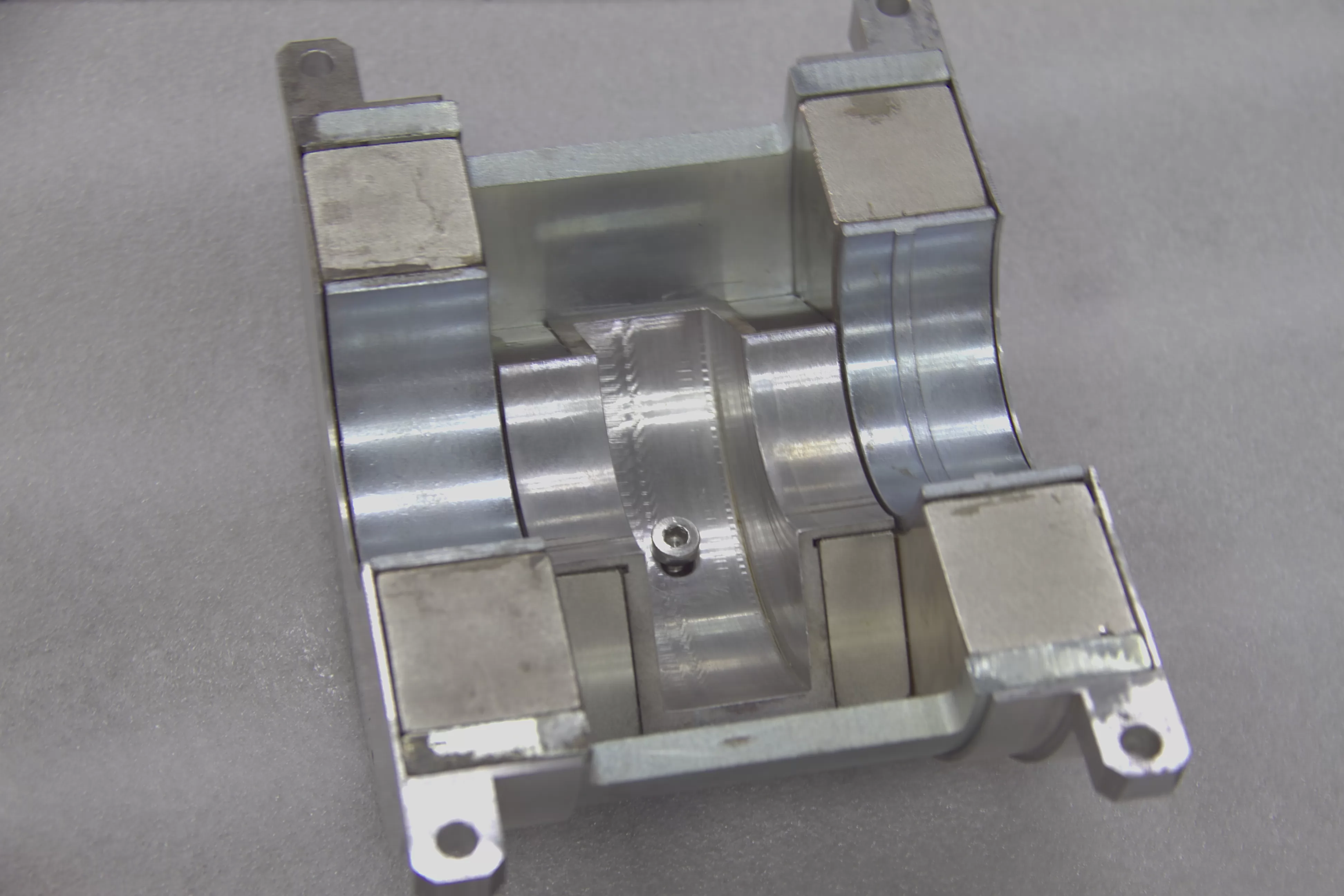
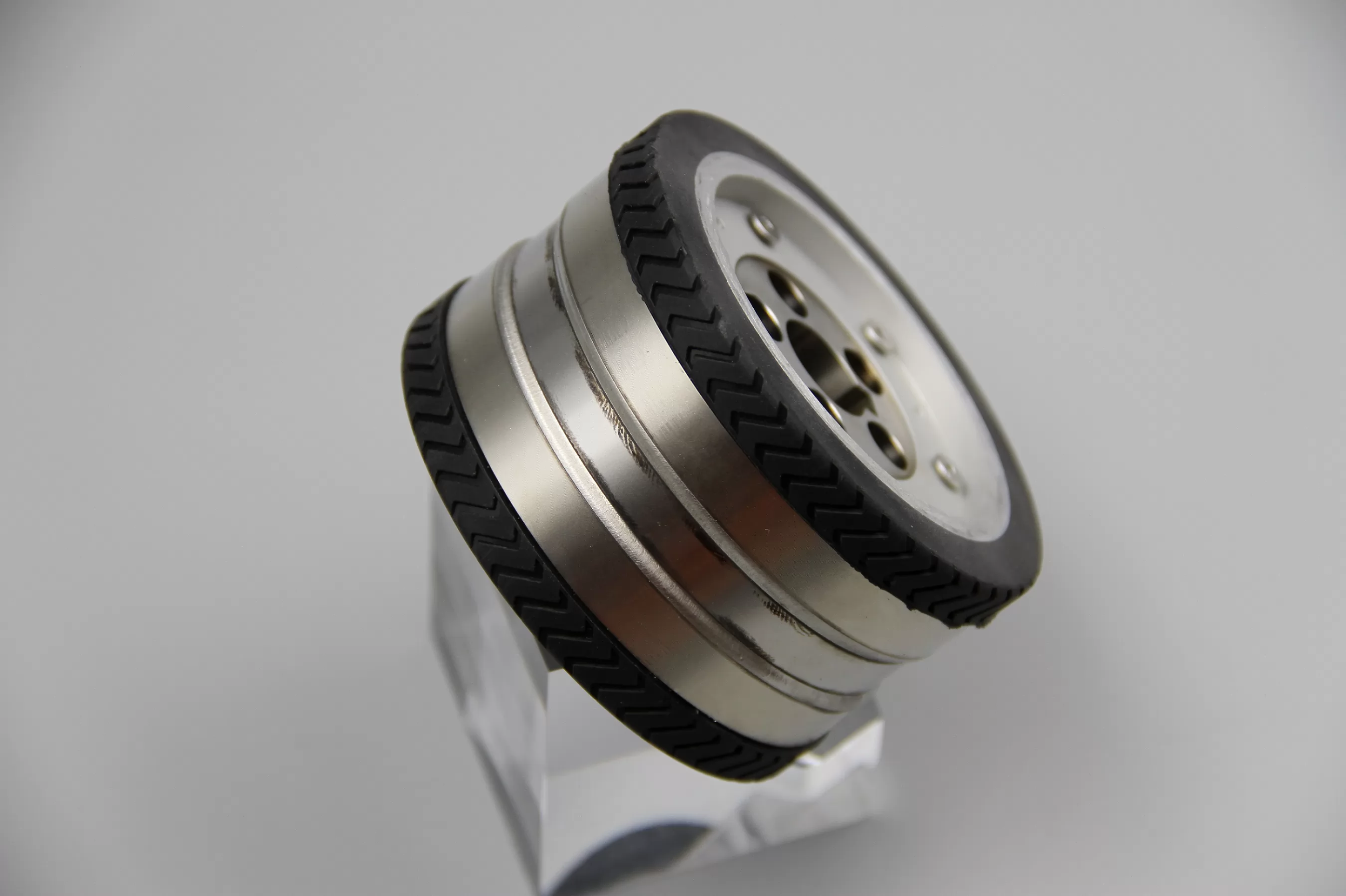
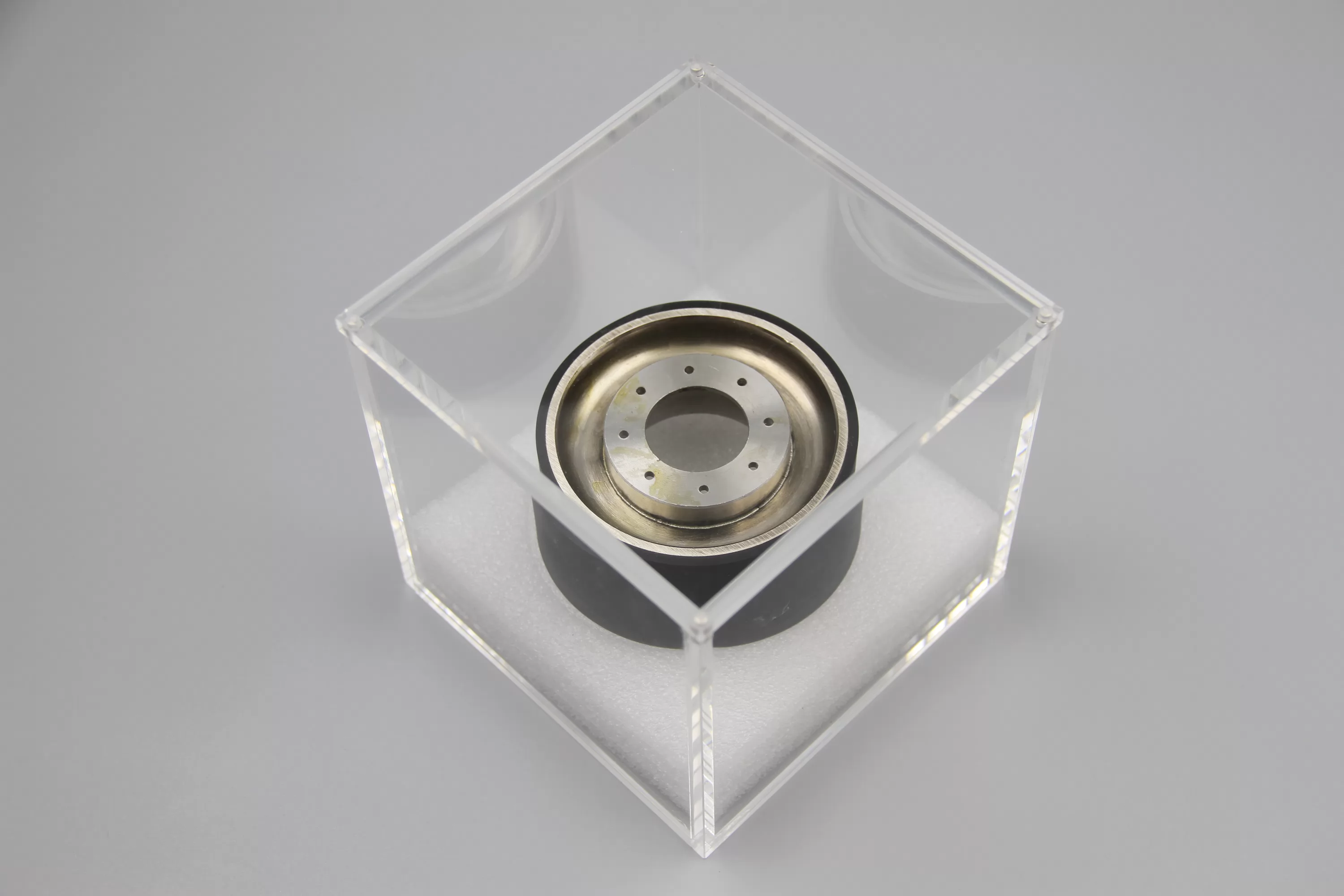
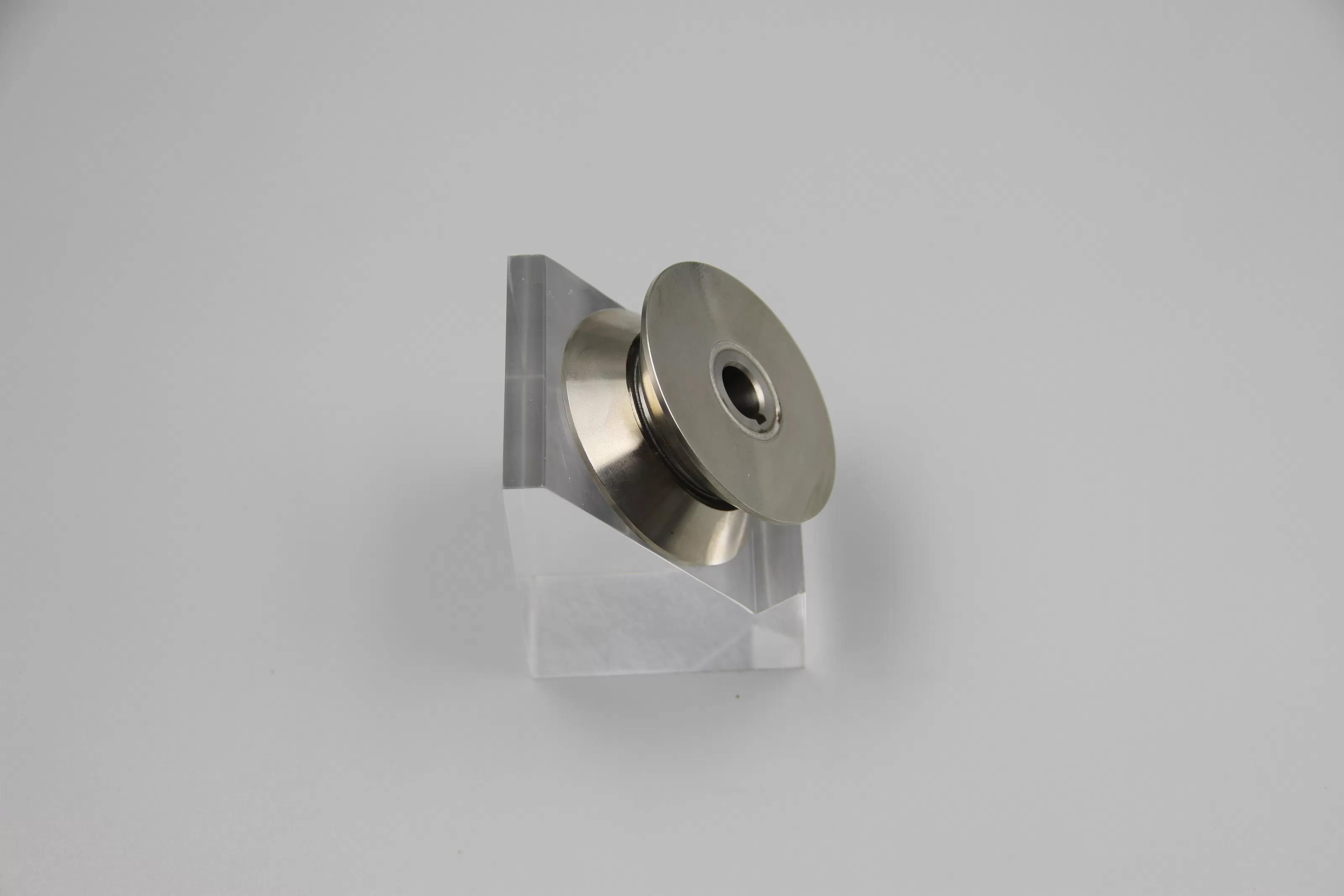
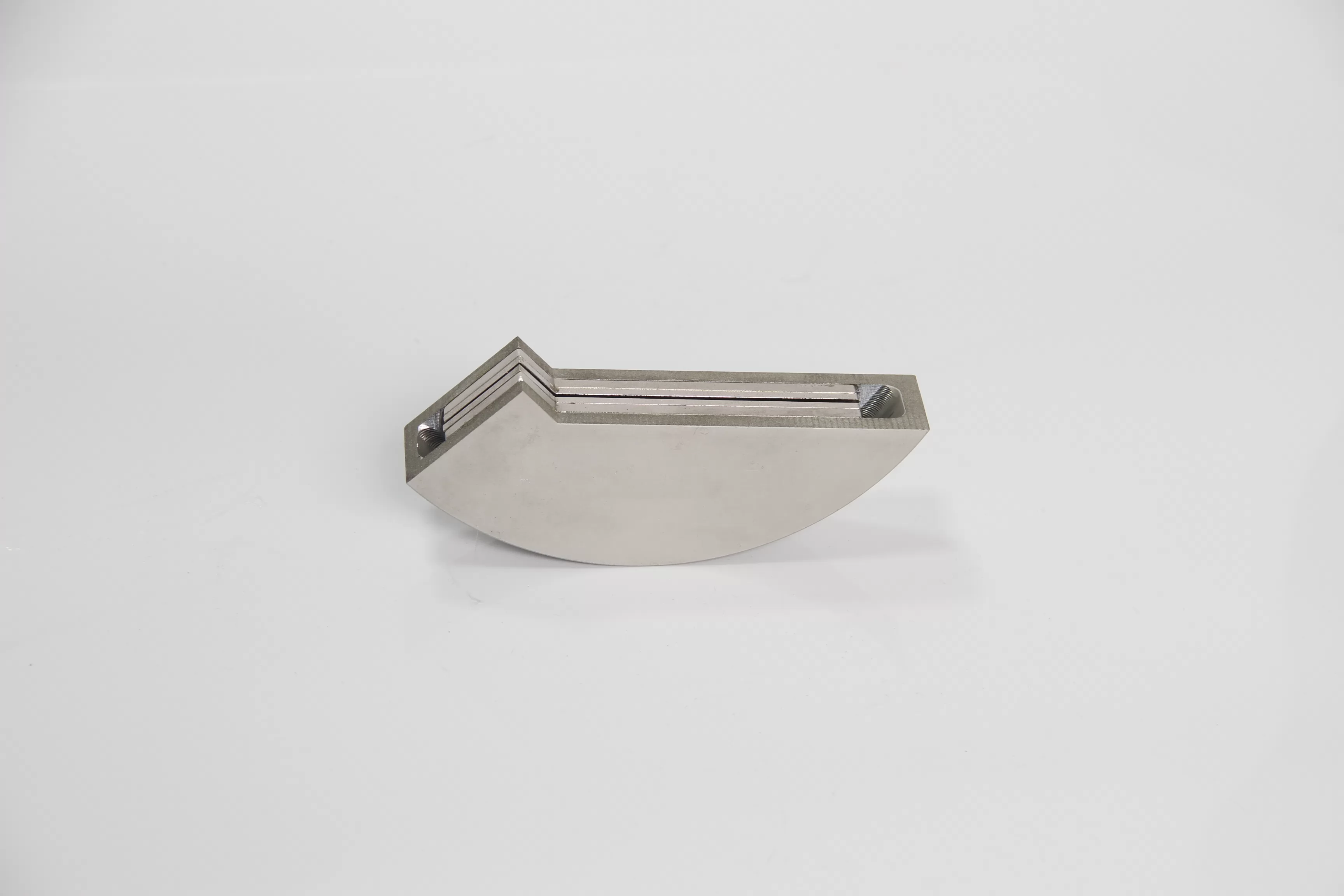
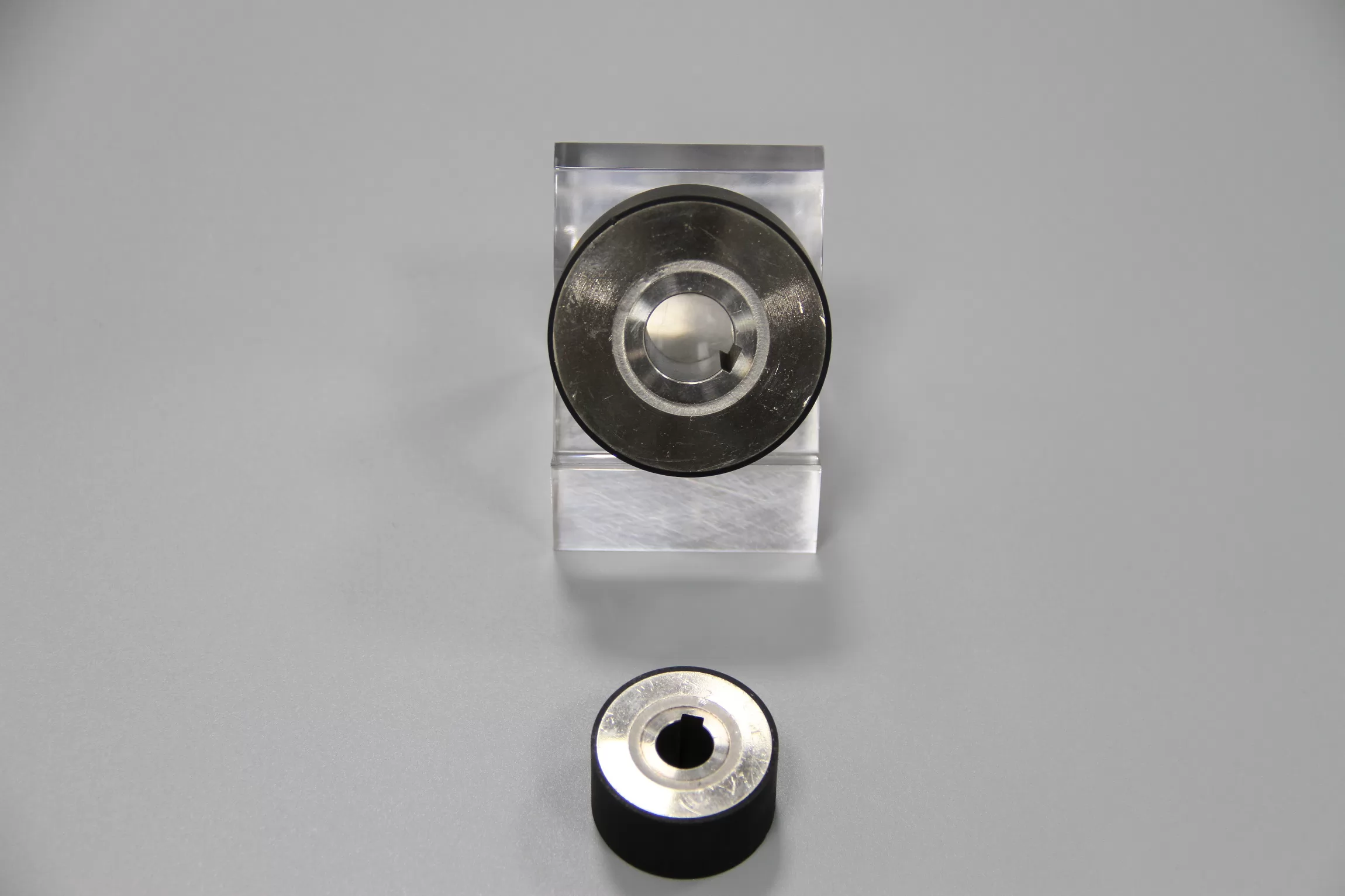
This section is reserved for displaying FAIZEAL's historical custom magnetic wheel product photography for global customers, including but not limited to the following case directions:
• Wind tower cylinder outer wall inspection magnetic wheel set
• Ship hull rust removal magnetic wheel set
• Storage tank inner wall inspection magnetic wheel set
• Pipeline inspection miniature magnetic wheel set
• Bridge steel box girder internal inspection magnetic wheel set
• Nuclear reactor pressure vessel inspection magnetic wheel set
• Offshore platform climbing operation magnetic wheel set
• Food-grade pharmaceutical reactor cleaning magnetic wheel set
• High-rise building exterior wall cleaning magnetic wheel set
• Explosion-proof climbing robot magnetic wheel set
10. SEO Keyword Index
Primary keywords: magnetic wheel, wall-climbing robot magnetic wheel, magnetic crawler wheel, permanent magnet adhesion wheel, magnetic drive wheel, magnetic wheel manufacturer, magnetic wheel supplier, magnetic wheel OEM, magnetic wheel custom, magnetic wheel China.
Secondary keywords: cylindrical magnetic wheel, tile-type magnetic wheel, arc-shaped magnetic wheel, NdFeB magnetic wheel, SmCo magnetic wheel, magnetic wheel for ship hull, magnetic wheel for wind tower, magnetic wheel for storage tank, magnetic wheel for steel structure, magnetic wheel for pipeline, magnetic wheel for nuclear reactor, magnetic wheel for bridge.
Long-tail keywords: magnetic wheel high load capacity, magnetic wheel IP68 sealing, magnetic wheel explosion proof ATEX, magnetic wheel food grade NSF, magnetic wheel high temperature 200°C, magnetic wheel low temperature -60°C, magnetic wheel miniature Ø10, magnetic wheel large Ø200, magnetic wheel custom engineering, magnetic wheel FEA simulation, magnetic wheel fail-safe adhesion, magnetic wheel zero power adhesion, climbing robot magnetic wheel, magnetic crawler inspection robot, permanent magnet wall climbing wheel, magnetic wheel 24-hour quotation.
Application keywords: ship hull cleaning robot, wind tower inspection robot, storage tank inspection robot, steel structure inspection robot, pipeline inspection robot, nuclear reactor inspection, bridge inspection robot, high-rise building cleaning, firefighting climbing robot, chemical reactor cleaning, defense climbing robot, mining inspection robot, NDT inspection robot, underwater ROV inspection, climbing robot OEM.
FAIZEAL — Custom Permanent Magnet Magnetic Wheels, Tile-Type Arc Magnetic Wheels, and Wall-Climbing Robot Magnetic Adhesion Systems. Ningbo, China. Established 2017. Sintered NdFeB and SmCo permanent magnet materials. ISO 9001 quality management. Global shipping. Engineering support in English and Chinese. 24-hour rapid quotation for custom designs.
0
Comments
Leave a Comment
Your email address will not be published. Required fields are marked *
Name can't be empty
Email error!
Message can't be empty
😍
😜
😳
😌
😄
😘
😝
😒
😃
😚
😚
😛
😟
😧
😀
😉
😓
😱
😤
😣
😂
😥
😩
😠
😢
😭
😰
😨
😡
😆
😪
😅
😐
😇
😋
😴
👿
😕
😏
😷
😵
😟
😮
😯
😑
👧
👴
😧
😬
😾
👶
👱
👵
👸
🙀
👺
👦
👩
👨
😽
😿
🙈
💩
💥
💤
😼
😹
🙉
🔥
✨
💦
👎
✌
👆
👈
💪
💹
👍
👊
💴
💶
💷
💸
👉
💵
🙏
🌎
🏧
👏
💳
👇
💑
🙆
🙅
💁
👫
👭
🙎
🙇
👑
👔
Submit Comment
Most Popular
-
 Sep 27, 2023What is a Magnetic Wheel and How Does it Work
 -
 Dec 25, 2024Top 10 Ndfeb Magnet Manufacturers and Suppliers in the World 2025
 -
 Jun 18, 2026What is a Magnet Made of and How Does it Work?
 -
 Sep 16, 2026Operation of Non-contact Magnetic Couplings


Laster Blogs


Set A Consultation Today
Name can't be empty
Email error!
Send Your Message
*We respect your confidentiality and all
information are protected.