
+86-574-87520996
sales@fzmag.com
How a small engineering team spent five years turning a German company's "not quite right" magnetic wheel into the go-to component for the wall-climbing robotics industry
Magnetic Wheels: The Driving Force of Modern Factories
Permanent Magnetic Adsortion For Wind Power Wall-Climbing Robot
FAIZEAL's self-developed Sealed magnetic wheel with rubber wrapping - Faizeal
OEM Customized tile-shaped Magnetic Wheel - Faizeal
From 2020 onwards, we started getting inquiries from robot companies — joint motor rotors, encoder rings, Halbach array samples. Our main business at the time was standard NdFeB assemblies for export (motor magnets, encoder magnets, magnetic couplings), with stable customers but a visible ceiling. Robots? We didn't take it seriously at first. We thought it was a few one-off inquiries.
Then they kept coming in denser and denser: Unitree, the Tesla robot project, several quadruped startups raising money, and overseas cobot customers started transferring in. We realized: this wasn't one-off, this was a trend. But which specific direction to go, we had no idea at all at that point.
We actually tried a whole bunch of things: joint motor rotors, encoder rings, magnetic wheels, maglev demo pieces — basically anything we could think of and make samples for, we made a batch and sent to customers.
Joint motors and encoder rings — the established big players had this market completely covered. Going in there was just competing on price with margins so thin you couldn't see the bottom. Maglev-style concept products — the market wasn't there yet, orders were nowhere in sight.
What finally brought us here was a customer building ship-cleaning robots reaching out to us directly. They sent us a sample from a German company — bulky, heavy, exposed magnets, insufficient holding force. Talking to them made it clear: nobody was doing this product right, but the need was real. We said: fine, we'll do this.
Before we started, we did our homework. We spent three weeks studying the products available on the market. The most mature magnetic wheel at the time came from a German company.
We bought their samples, tore them apart, and had customers run them in real working conditions for comparison. Their problems were very obvious:
First, they were heavy. An Ø80 magnetic wheel weighed close to 2 kg. For a wall-climbing robot, the total machine weight is typically controlled at 8–15 kg, and a magnetic wheel system usually needs four wheels. Just the wheels eat half the budget, leaving almost no room for cameras, sensors, cleaning tools, and batteries.
Second, the magnets were exposed. Their design had NdFeB arc segments exposed on the outside of the wheel, covered only with a thin layer of epoxy. In salt spray, oil mist, or seawater industrial environments, this was a disaster waiting to happen.
Third, the holding force was insufficient. We measured it ourselves: their Ø80 wheel on a 10 mm S235 steel plate only delivered 250–300 N of holding force. That was barely enough for a 5 kg robot to cling to a vertical steel surface, with no margin for cameras or tools.
The application scenarios were severely limited. Customers couldn't use them for ship hull cleaning or oil tank inspection — the corrosion problem was unsolvable.
We realized: it wasn't that the track was wrong, it was that the products on the market at the time weren't done right. If we could solve the "lightweight + high holding force + high corrosion resistance" combination, the market was wide open.
In September 2021, we put together a small team: two magnetic-circuit engineers, one structural engineer, plus two production-line veterans for process support. The goal was simple: in 30 days, deliver a working sample that matched the German competitor's dimensions but solved each of their problems.
A few key design decisions:
Material: N42SH sintered NdFeB. Not the top grade, but stable and well-supplied. The first version wasn't the place to gamble.
Geometry: Cylindrical wheel body, outer diameter Ø60 mm, standard keyway bore (Ø8 H7) for axial shaft mounting, steel housing wrapping the magnet ring. The steel shell acted both as a flux concentrator and a structural part.
Magnetic circuit: The first version was NOT Halbach — 8-pole radial multi-pole, simpler process, validating the basic concept first.
Assembly: Steel shell and magnet ring press-fit with interference, end caps epoxy-potted.
Three weeks, mostly spent on two things: the tolerance chain of the steel shell inner wall (which determines whether the magnetic circuit gets shorted) and the interference amount (NdFeB is brittle — the magnet ring edges chipped during press-fit if the interference was too aggressive).
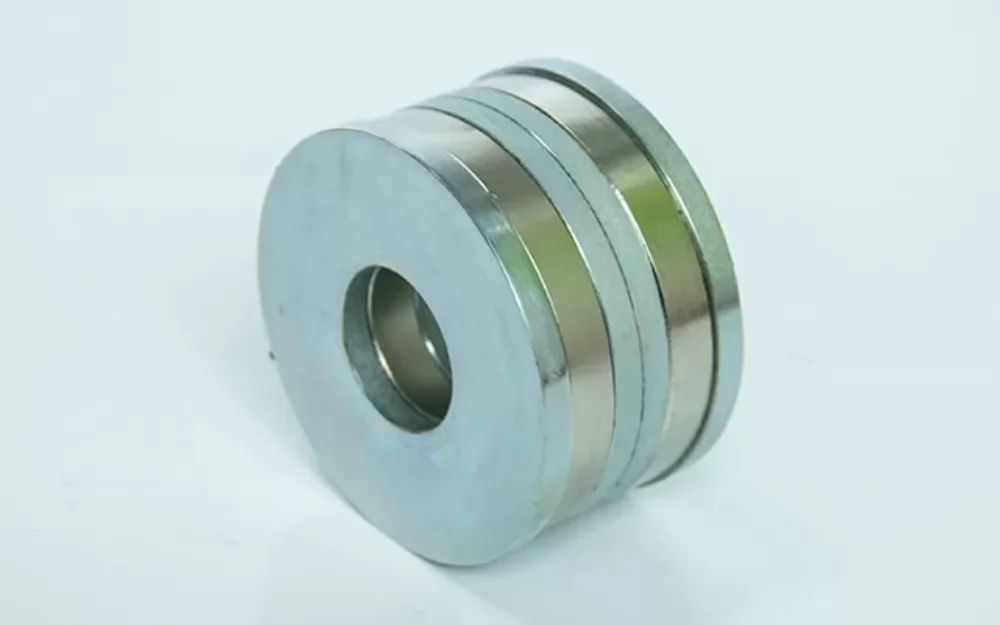
At the end of week three, the first sample came off the line. It weighed 820 g, lighter than the German Ø80. Holding force on a 10 mm steel plate: about 360 N — roughly 20% stronger than the German competitor at the same size.
Not perfect, but the direction was right.
We sent 5 samples to three early wall-climbing robot customers we'd been in contact with, and asked them to try them on site.
Customer feedback came by email every two weeks. But what they told us was nothing like what we had originally imagined.
Our original assumption about the main applications was building façade inspection, fire safety, and bridge inspection. What actually showed up — the overwhelming majority of customers were in ship cleaning and the oil industry.
Ship hull cleaning robots — a scenario we hadn't thought about at all. Companies in Europe and the Middle East that make robots to remove barnacles and rust from ship hulls without sending human divers into the water. They found that magnetic adhesion was 10× more efficient than traditional high-pressure water + human cradle approaches. The need was real, but one thing had to be solved: seawater corrosion.
Oil tank inspection robots — customers from major Asian oil & gas companies, looking to inspect weld seams and assess corrosion inside large crude oil storage tanks. The tank interior is a hydrocarbon vapor environment, with temperature cycles from -10°C to +60°C, and periodic steam cleaning. The corrosion-resistance requirement was extreme.
Feedback from both kinds of customers was the same sentence: "The design is good, but it can't survive our environment."
Our first-generation magnetic wheels failed in both scenarios within two months: the epoxy potting layer cracked under thermal cycling, the steel shell weld seams started to rust, and the magnet ring edges powdered under salt spray.
This was a signal: we could serve the conventional industrial customers, but the real incremental market — ships and oil — required fundamental redesign.
We spent almost two months on the second iteration. This version's changes were revolutionary, not patches:
First, full magnet encapsulation. Completely sealed structure. No potting compound between the magnet ring and steel shell — all mechanical interference fit + laser-welded end caps. The NdFeB surface is zero-exposed; nothing can touch the magnet itself.
Second, all-laser welding. Original arc welds and spot welds were all converted to laser welds. The weld seams are narrower, denser, and visually much cleaner. This matters a lot for rolling operation — protruding weld seams cause bumping and noise on the steel plate; laser welding is almost flush with the base material.
Third, Halbach array. This time we committed: switched from 8-pole radial multi-pole to a 4-segment Halbach array. The result was significant: air-gap flux density increased by about 35% with the same magnet volume. This single change pushed our holding force up a tier.
Fourth, full nickel plating. Steel shell outer surface Ni 20–25 μm plating (Ni-Cu-Ni three-layer), replacing the original epoxy coating.
Comparison of the parameters after the change:
· Weight: 760 g (first-gen was 820 g)
· Holding force: 580 N on 10 mm steel (first-gen was 360 N)
· Corrosion grade: passed 1000-hour neutral salt spray test
· Weld seam height: <0.1 mm (laser welding)
Holding force greatly increased — at the same Ø60 size, our wheel delivered more than 50% higher force than the German competitor's Ø80.
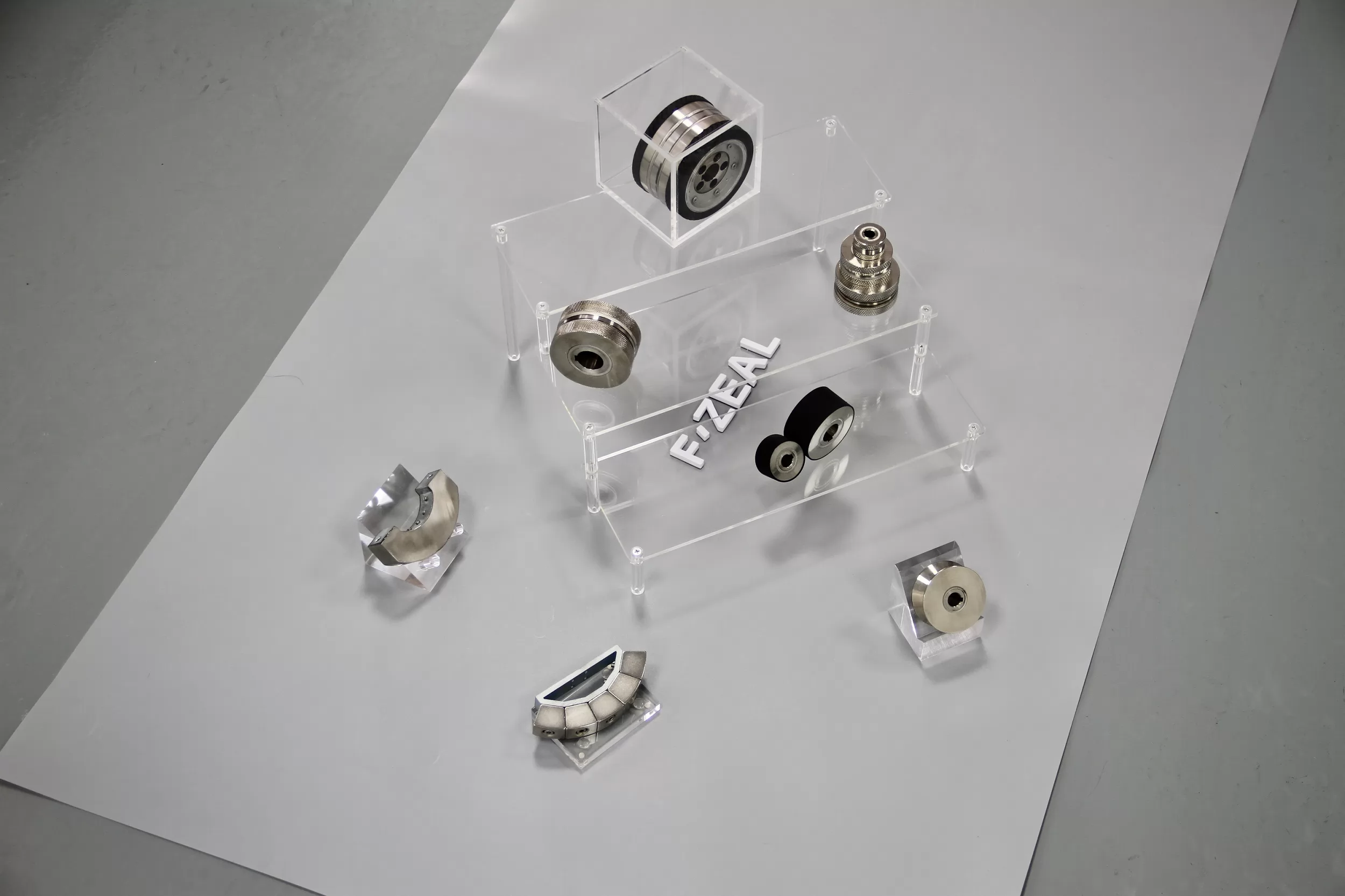
This became what we later called our "regular" magnetic wheel — and it is the design that most wall-climbing robot magnetic wheels on the market today reference. The most prominent cylindrical magnetic wheel on the F·ZEAL-branded acrylic display stand is this one.
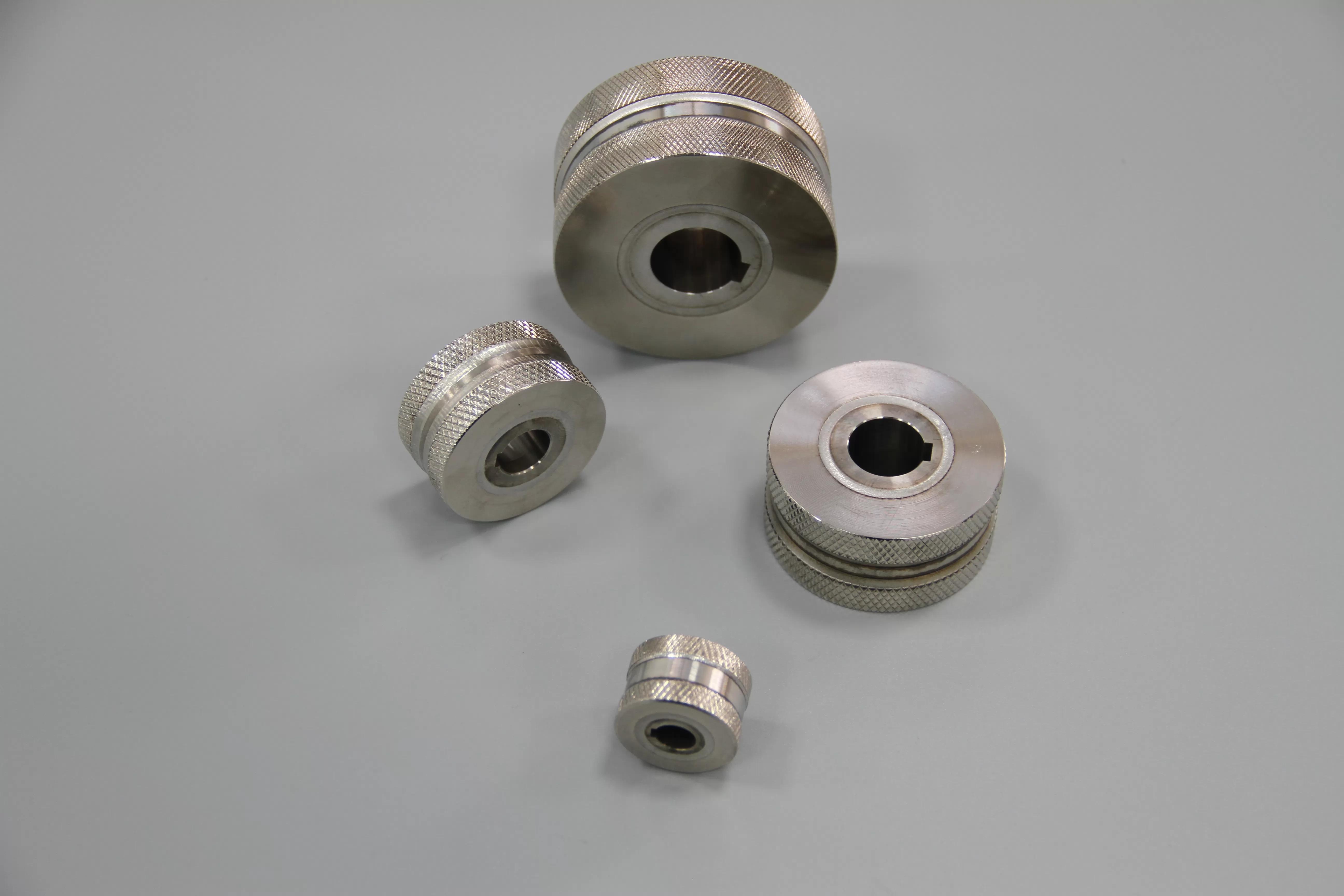
After the improved regular magnetic wheel went to market, customers began long-term real-world validation. A few cases we keep in mind:
North Sea ship hull cleaning robot — A European customer mounted our Ø60 regular wheel on their cleaning robot and operated it in the North Sea for 6 months. Side-by-side comparison was the German competitor's Ø80 — the German wheel began rusting at 2 months and the magnet ring edges powdered at 4 months. Our wheel, disassembled at 6 months, showed essentially no visible corrosion and holding force decay of <5%.
Middle East crude oil storage tank inspection — The customer added an extra polyurethane rubber over-molding on top of our wheel (this rubber-over-mold solution later became their "rubber-coated anti-corrosion version" in the fully customized bulk order). The wheels ran inside tanks for 12 months. Hydrocarbon vapor, -10°C to +60°C cycling, periodic steam cleaning — holding force and appearance both passed.
Wind turbine tower magnetic crawler robot — The customer used our smallest Ø40 regular on their inspection robot to climb 80-meter onshore wind turbine towers. The robot stayed on the wall even in typhoon-strength wind. The customer's words: "Other solutions we tried before were either too heavy or had insufficient holding force. F·ZEAL's is just right."
High-speed train underbody inspection robot — A depot maintenance scenario, where the robot crawls on steel plates between rails under train cars. The operating conditions aren't that harsh (mostly indoor), but the requirements for noise and cleanliness are strict. Laser welding's flush seams paid off here — crawling was almost silent.
These customer validations gave us a clear signal: the regular version was ready for mass production.
Once the regular version was proven, custom orders followed. The three most representative ones:
Rubber-coated anti-corrosion version — A Singapore ship-cleaning customer needed: their robots operated in tropical waters long-term, with high seawater temperature and severe biofouling. We over-molded the entire outside of our regular version with 2.5 mm chloroprene rubber (CR). The wheel's friction coefficient jumped, and biofouling was easier to wash off. The rubber layer was fixed to the steel shell with both an epoxy primer coat and a mechanical snap ring. Holding force dropped about 8% after rubber over-molding, but the friction coefficient nearly doubled — not slipping while climbing was actually the more important metric in real working conditions.
Super lightweight version — A European drone-mounted inspection customer was extremely weight-sensitive (every gram counted toward flight time). We replaced the steel shell with TC4 titanium alloy (Ti-6Al-4V), bringing the wheel from 760 g down to 380 g. Magnetic circuit unchanged, holding force unchanged. The cost was a 3× unit price — but the customer paid for it because the extended flight time economics far outweighed the wheel cost.
Aluminum version — A more unusual customer: they made inspection equipment that operated near precision magnetic sensors, requiring the wheel body itself to be completely non-magnetic. We made the shell from 6061-T6 aluminum, with a thin-wall non-magnetic steel bushing inside acting as the magnetic-circuit flux concentrator. The aluminum shell itself doesn't participate in the magnetic circuit — it's purely structural. Volume for this version wasn't large, but the process was tricky — aluminum and steel have completely different heat treatment processes, and during assembly, no magnet could be contaminated with aluminum chips.
All three custom versions eventually evolved into our standard product lines. Looking back now, customization capability is the real moat in this industry — anyone can copy a regular version, but being able to take on a customer's real engineering problem is a different story.
I'm writing this in 2026.
Five years have passed. Today, when you open any wall-climbing robot company's website, any technical white paper on wall-climbing robots, or any teardown video of a wall-climbing robot, you see that "cylindrical, fully encapsulated magnets, laser welding, Halbach array, Ni plating" design — the prototype and mass-production process for this product were developed by our engineering team. Absolute original work.
It wasn't copied from the German competitor (their design is completely different from ours in structure, magnetic circuit, and corrosion protection). It wasn't copied from any domestic peer (we were the first in China to make this structure). It started from that "30-day hard push" in 2021, and was iterated step by step from the actual working-condition feedback our customers gave us.
There are peers in the market making similar-looking products now. Some of them may be technically equivalent. But the original engineering definition — "full encapsulation + laser welding + Halbach + Ni plating" — was made by us first, and has been validated for long-term reliability in multiple markets.
We're not saying this to argue with anyone. We think customers, when selecting a critical component, should know one thing: who first made the conventional magnetic wheel that the industry now widely uses. When reliability issues come up, who they should turn to for review.
Over five years, we've made more than a dozen magnetic wheels: cylindrical, arc-segment, hub-mount, rubber-coated, titanium, aluminum-shell, high-temperature, nuclear-grade... Behind every version is a real customer scenario.
Wall-climbing robotics, just as we judged back in 2020, is entering its breakout phase. Ships, oil tanks, wind power, buildings, nuclear, fire safety — every sub-segment's scale is rapidly expanding. The magnetic wheel, a seemingly modest component, is becoming an increasingly critical link in the wall-climbing robot supply chain.
We'll keep going.
For magnetic wheel selection, custom sizing, material recommendations, or sample requests, please feel free to reach out — FAIZEAL can provide technical support.
www.fzmag.com sales@fzmag.com


